Author: Andrea James

  • Don’t let unconscious inertia decide for you

    One thing I am loving about coaching is that I get to enter into someone’s life or business as a co-mind on decision points. Coaching helps people not only make better decisions, but also identify when a decision needs to be made, or doesn’t.

    A key question to ask yourself about a certain action is: Am I doing this as a result of a conscious decision? Or is the action the result of unconscious inertia?

    Unconscious inertia is when your actions are the result of not questioning the status quo, or the decision process gets stuck just below the surface of active thinking and awareness.

    Four random examples:

    1.) A small firm has grown to the point where it could justify hiring another employee to share the workload. Hiring the employee would bring more breathing room into the schedules of the principal or owners. However, hiring the employee is risky. What if business trends down? Nobody wants to have to lay someone off. And so, nothing is done.

    But there’s a decision point in there. Maybe, the risk of hiring an employee is too great and you make the decision not to proceed. That’s OK. Or maybe, after some more financial analysis on risk/reward, you feel confident opening the position and seeking the right hire. If I were coaching such a scenario, I’d also gently point out that interviewing candidates is still not hiring them, it’s just exploring a potential future reality and seeing how it sits with you.

    2.) A couple has lived together for seven years — ever since graduating college. They are approaching age 30 and have not married. Days pass and no decision is made. Is it possible to make a decision that takes unconscious inertia and replaces it with decided action? Especially with something as big and sometimes scary as committing to a life partner, you can use smaller decisions to lead to bigger decisions. Maybe you even decide to not decide until a future date. What good does that do? It forces conscious thinking into your actions.

    3.) One of my favorite decisions is choosing to invest in a sabbatical, a period of time to honor one’s life transition and figure out one’s next step. Isn’t that a beautiful decision? You’re not picking your next step, you’re deciding to give yourself time to decide. Then, your days are considered and active. (Plug: A sabbatical is a great time to invest in yourself with a professional coach.)

    4.) You invested in a stock and it’s moved in a particular direction, or has done nothing at all. Do you buy, sell, or hold? Buying or selling are obviously the result of a conscious decision. “Holding” should be, too.  (…Gosh, I love the lessons of the stock market — are they not applicable to life, or what?)

    So long as you’re not causing undue pain to others, there is probably no right or wrong decision.

    Just don’t let unconscious inertia decide for you.


    If you liked this post, you might like:

    Maximize the moment, and jump. A state of uncertainty is nerve-wracking. Nobody likes limbo.
    Forgive yourself for not knowing what you didn’t know before you learned it
    Don’t be paralyzed by imperfection
    Down with gravity; up with entropy!
    The mob asks the wrong questions
    Simple life lesson: Following a leadership pattern
    Five ways to lead a more analytic life
    A paradox of modern life: Comfort is a noose
    Ask not receive not: Advice on questions
    Why the passage of time confounds us
    Applying Wall Street logic to your life
    The double workday, makers and managers

  • The mob asks the wrong questions

    By now, most of us have heard the tragic story of Harambe the gorilla.

    In case you missed it, the gist of what happened is this: A toddler fell into the gorilla enclosure at the Cincinnati zoo. Harambe, a 400-pound gorilla, saw the boy sitting in the water and stared at him for a bit. A few times, Harambe pulled the boy through the water quickly, moving the boy to a different location. A full video shows the encounter. Forced to decide quickly, zoo officials killed Harambe with one shot to the head and later said that a tranquilizer dart would have agitated the gorilla and would have taken too long to kick in, putting the boy’s life at risk.

    Beyond being sad for everyone involved and wondering how much a new gorilla would cost the zoo ($100,000 to $200,000 it turns out), I had mostly put this story from my mind.

    But as is usually the case when animals get killed, mob mentality went wild. People saw themselves in the event and felt invited to share a conclusive opinion on who is to blame. The media took the ongoing interest and ran with it.

    And this is where the story gets interesting for me again — not the event itself, but the reaction to the event and the questions that people are asking and not asking about it.

    Consider the analysis of the mob. The dominant themes on social media seem to revolve around the following:

    1. An excoriation of the mother of the child as negligent, complete with threats against her life

    2. Defense of the mother and all parents in general. (To that end, Washington Post’s Amy Joyce has a good take: “Remember that time you were a perfect parent every minute.”)

    3. A debate over whether the gorilla was attacking the child, protecting the child, playing with the child, or something else.

    The fact that the mob’s blaming questions and conclusions all focus on the immediate actors — the boy, the mom, the gorilla — reveals a lack of critical thinking. The mob is often narrow-minded and can’t see past the end of its collective snout.

    There are smarter, bigger, more illuminating questions to ponder. Questions that evolve us even farther from the apes.

    Personally, I’ve always liked the follow the money approach to analyzing any situation.

    I present the following questions without judgment, and without any real conclusions myself, for the sake of a more rational, intelligent societal discussion:

    1. What is the risk / reward profile of operating a zoo, and is it worth it?

    2. The Cincinnati zoo brought in $40 million in revenue last year, 16% of which, or $6.5 million, came from taxpayer subsidies. Is the zoo something that the taxpayers believe enhances the city? Are taxpayers happy with the subsidy? Are they paying the right amount?

    3. Did you know that zoos have dangerous animal response teams tasked with keeping the public safe? Can we accept that if we are going to cage animals and charge people money to look at them, there is inherent risk to that? Are the risks worth it?

    4. Can we accept and understand that all activity carries risks and that the only way to eliminate risk is to eliminate the activity, and even then, you might introduce a new set of risks? Accepting that, how does the discussion evolve?

    5. The Cincinnati zoo has $17 million worth of notes payable and bonds payable. Does the tragedy put that debt at risk? What assets secure that debt?

    6. What tradeoffs were made between having a clear line of sight to the animals and having an enclosure that could be fallen into, in the first place? Was that tradeoff worth it? Would a giant piece of plexiglass, or metal bars have been better, or would such a design ruin the public’s viewing pleasure?

    7. How much would it cost to have a double moat enclosure, or a better design that would prevent anyone from falling directly into the gorilla area? Is the cost worth it?

    8. What’s the elasticity of demand on admissions pricing? Would you pay an extra $2 for your zoo ticket to have a space where it isn’t physically possible for kids to fall into enclosures? Would you pay an extra $10?

    9. A tragedy happened and cannot be reversed. Now what? What other questions should zoo officials ask themselves? Taxpayers? Zoo goers?

    Ask more questions and poke holes in the conclusions of the mob — that’s my take.

    Edited to add:

    A lawyer friend shares that my post reminds her of a legal formula used to calculate negligence. The formula is as follows:

    If (Burden < Cost of Injury × Probability of occurrence), then the accused will not have met the standard of care required.
    If (Burden >= Cost of injury × Probability of occurrence), then the accused may have met the standard of care.

    Wikipedia link to the concept of the calculus of negligence.
    Wikipedia link to the judicial philosopher, Billings Learned Hand, (what a name!), who came up with the standard.


    If you liked that post, you might like:

    Economics should be taught in schools. Period.
    Simple life lesson: Following a leadership pattern
    Simplicity gains momentum, but at what cost?
    Finding “meaning” in the for-profit realm
    The world is going to end on Saturday
    The world didn’t end. What did you learn?
    Maybe you are good at math and never knew it
    Are you secretly good at math? Five more clues
    Five ways to lead a more analytic life
    Politics is just politics, not citizenship nor community
    A paradox of modern life: Comfort is a noose
    Ask not receive not: Advice on questions
    Why the passage of time confounds us
    Applying Wall Street logic to your life
    Vociferation of meaningless numbers
    Don’t be paralyzed by imperfection
    Maximize the moment. And jump.

  • Two mind tricks to quiet your thoughts for sleep

    A high-intensity, high-performance career* will keep you up at night.

    Illustration called "planetary brain," created by Flickr user Adrian Kenyon and shared under the creative commons license.
    It’s great to have an active mind — but sometimes we need to train it how to quiet down. (Illustration called “planetary brain,” created by Flickr user Adrian Kenyon and shared under the creative commons license.)

    My mind is not the sort that can just shut off at will. Also, I’ve always been in careers that are mentally intense and involve producing work for public critique and consumption.

    As a business reporter, when my head hit the pillow at night, my mind would race over the details of my article that would be on the front page of the newspaper the next day. Every single detail had to be accurate — from name spellings to calculations to quotes — and mistakes meant public embarrassment plus career-destroying printed corrections.

    As a stock analyst — particularly during the quarterly earnings seasons — I would finish my work and I had a mere four to six hours to sleep before I had to wake up and sell my research to Wall Street. This means that I would finalize updating a complicated Excel model, write a report, paste in my financial tables, and file the report electronically before going to bed. There often wasn’t transition time between “working” and “not working” — no time for a glass of wine. So then, I’d find myself laying in bed with numbers dancing in my head. I wondered where I could be wrong, which fact I might have missed that could embarrass me in front of clients the next day. My mind was a jumble of data points — revenue trajectory, gross margins, currency fluctuations, tax rate, execution risks, management’s body language, investor expectations, where the stock trended in the after-market. Hours of brilliant work on a deadline would be useless if I misplaced one decimal point in a spreadsheet of tens of thousands of cells.

    When I spoke with investors about my stock calls, I would say, “Here’s what keeps me up at night,” and I wasn’t speaking in metaphor — the job truly kept me up at night!

    Caring about the work you do is an innate strength. Knowing how to turn it off is a learned skill.

    Ok. So. Taking my work less seriously was never an option. So how does one sleep with all that?

    Because my brain would not stop on its own, I had to give it something else to do.

    These two things always worked for me. These are my personal versions of counting sheep.

    One. The fisherman. I imagine a small boat floating above my head. A friendly fisherman casts his net into my brain and scoops out all the thoughts. Sometimes, it takes two or three scoops to get them all. But when he’s done, my mind is clear and I don’t remember what happens after that, as I am in dreamland!

    Two. Kickball. Remember those red kickballs we played with as kids? You’d kick the ball and it would make a satisfying boink! and go flying? Well, in my mind’s eye, I place myself in my own small yard. The fence around the yard is high and I am standing in lush green grass. The goal is to keep the grass clear. As thoughts come in over the fence, I run over and kick them out.

    The kickball mind trick is particularly helpful if someone else’s unkindness toward you keeps replaying in your head. Turn those mean words into a kickball and boot it out of your zen yard! Boink! Boink! Boink! Sometimes two or three balls would come in at a time, and I’d kick those suckers right back out.

    You probably have tips to share, too! At the end of an intense day, how do you turn it off? What techniques do you use?

    *Parenting too. It is intense and it counts. It counts. It counts. It counts.


    If you liked this post, you might like:

    Sleep deprivation is literally torture
    Outsourcing versus insourcing your own life
    How to become a runner (inspiration for everyone)
    Don’t be paralyzed by imperfection
    Down with gravity; Up with entropy!
    When the world underestimates you, keep showing up
    Forgive yourself for not knowing what you didn’t know before you learned it

  • Forgive yourself for not knowing what you didn’t know before you learned it

    I have one quote taped to the wall of my office.

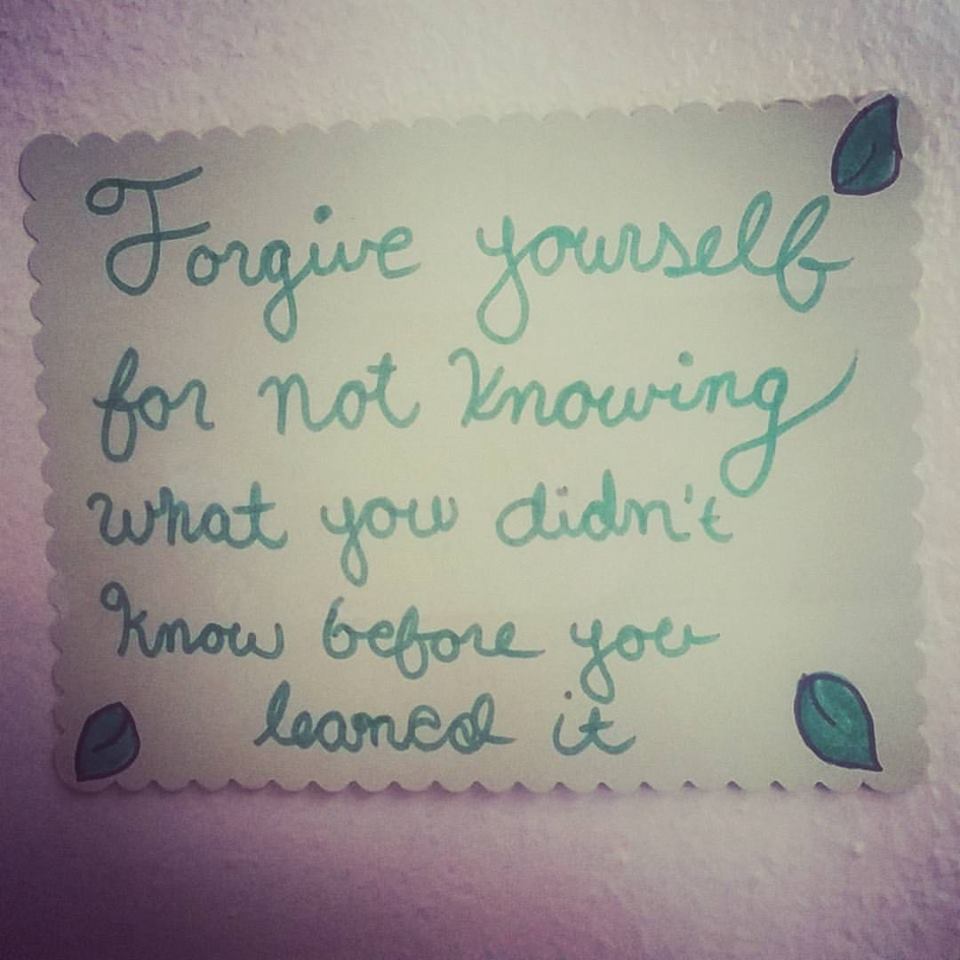
    “Forgive yourself for not knowing what you didn’t know before you learned it.”Forgive yourself for not knowing what you didn't know before your learned it.

    True of stock investing. True of life, too.

    We are all beginners. There is never a time in life when we are not beginners at something. 

    (Aside: I pledged earlier this week to teach myself SnapChat. God help me!)

    Life is giving us an education. We are paying for that education and so are the people we make mistakes on. Yikes. But there is no other way.

    These two stories helped give me perspective over the years:

    One. President George Washington was a successful Revolutionary War commander and most of us know his success story. But, he made many mistakes as a young man in the French and Indian War. Washington’s men paid for his military education with their lives.

    Two. The famous book, “Man’s Search for Meaning,” is written by Viktor Frankl, an Austrian psychiatrist who survived the holocaust and three years in the camps, including Auschwitz. His odds of survival were grim — he was most likely to be killed right away, or worked until the last ounce of his energy had been spent, at which point he’d die of starvation, sickness, or a Nazi guard’s beating. He describes how every decision the prisoner made was a life or death choice. Should one choose this queue or that? He had mere seconds to decide with an incomplete information set. He could march in the direction of a prisoner work hut where he would live, or the gas chamber, where he would die. The lines were not marked. Luck and chance played a role. He could line up in a work group where the guards were in a bad mood and would later shoot him for no reason, or he’d line up with a more merciful guard who might slip a candy bar when no one was looking. These poor souls in the camps were forced to make fateful decisions without being able to see the future or the big picture.

    So, too, are we all making decisions with the best set of data we have. Only, if you’re reading this blog, the consequences for you won’t be nearly so dire, and what a relief.

    Go get ’em, rookie.

  • Why I won’t be on the Tesla call tonight

    Tesla Motors reports its quarterly earnings this evening, and for the first time in 21 quarters, I will not be on the call asking Elon Musk & crew a question.

    As of May 2016, I am stepping back from day to day coverage of Tesla Motors. I’ll remain affiliated with my firm as an advisory analyst and will be working behind the scenes with my analyst replacement.

    Here’s why.

    My office has a sloping ceiling, and on the slant just within my gaze are large stenciled numbers: 2061. That is the year that my life expectancy runs out, based on a typical aged 34 female. I rarely share this fact because it sounds a bit disturbing and morbid.

    But for me, it provides focus.

    I work better with a deadline.

    And I feel strongly that my work as a stock analyst is done and it is time for me to move on to other things.

    I am launching my own executive / professional coaching business, Solve for X Coaching, where I will work with executives and mid-career professionals on life transition and communication & leadership style.

    Being a Wall Street stock analyst on Tesla Motors (TSLA) shares from 2010 to 2016 has greatly enriched my life and understanding of the world. I took pride in the depth of my analysis and research — I always started from a position of skepticism and asking, “Where could Tesla go wrong?” But early on, it became clear that the bigger question — the world changing one — was, “Where could Tesla go right?”

    My firm gave me the opportunity to call the truth on Tesla as I see it. And we get to that truth by analyzing the following three questions, at their simplest: Does Tesla have a technology lead that is real? Can Tesla build it? Will people come?

    Answering those questions took me on a journey into researching battery pack manufacturing, touring battery manufacturing competitors, creating relationships with suppliers, and constantly talking with industry. My financial model, which I built from scratch, modeled out Tesla revenue and expenses for the next several years at a granular level — even at some points analyzing the costs of a lithium-ion battery down to the cathode, anode, electrolyte and separator. I have written volumes of research for Wall Street clients addressing Tesla-related topics. Unfortunately, that research is not available to the general public and was shared only with firm clients.

    Does Tesla have a technology lead that is real? Can Tesla build it? Will people come?

    Yes, yes and yes.

    The quarterly earnings conference calls were just a small part of my research on Tesla, but they were usually fun and productive. I have helped to generate some informative conversations with CEO Elon Musk, CTO JB Straubel and the rest of the Tesla team over the years — my questions have unearthed the Gigafactory plans, whether Tesla really needs to produce the Model X, and whether, given constraints, Tesla would build batteries for electric cars or solar storage. I’ll truly miss that part of the job.

    As an independent third-party analyst, I’ve always been prohibited from personally buying the stock. I can’t wait to buy in.

    May the 4th be with us.

    Onward.

  • How a year on Wall Street changed his world view

    This is a conversation with Andy Netzel, the smartest guy I ever hired. He’s also the only person I ever hired, but I like to think that I chose wisely.

    Like me, Andy is a former journalist who went into business. And like me, he is deeply curious about everything.

    Andy spent several months working for me and learning to analyze the world from a Wall Street point of view. He was able to contribute right away — as a former director of marketing at Hoover, Dirt Devil and Oreck, he deeply understood manufacturing and global distribution. He was a perfect complement to my own expertise developed from analyzing emerging technologies and global industrial companies.

    And then, unfortunately for us, Andy used his new-found skills to analyze his own career and left for an even better and more exciting opportunity. . . . Teach a man to fish . . .

    Several months working as a stock analyst shifted his entire worldview. Fascinating.

    Here’s a conversation between us about what he learned and a glimpse of what it was like working with me. I hope you get something out of it — particularly the value of the reframe. The lessons learned in investing about time and money can be applied to your own life and career, and vice versa!

    Andy: I look at the whole world differently now. That year on Wall Street was not a wasted time.


    Me: Wow. I would like to blog about how analyzing the stock market changes one’s view of the world. The problem is that I have done this so long that I forget how I looked at things before. I know that I changed a lot.


    I literally see everything as an equation now  — stuff I’m involved in and stuff I’m not. Business is even more rational to me than it was before.


    I love this. I can totally see it and I did not realize that I do this, too. Gosh, I even named my coaching company, Solve for X! That’s Tesla-inspired.


    I also see anyone speaking in black and white certainties as uneducated about a subject. One thing that Wall Street taught me is that assumptions are dangerous. And the deeper you believe in them, the more harm they can do. Also, the spoken story for everything is bullshit — even the really great journalists just don’t have the access and cache to see behind the curtain.


    I remember realizing this, too! When I was a reporter, I thought we got access to what really went on in companies and how things worked. I was so wrong. Being a stock analyst taught me a ton. I’m not sure you can really understand a thing without understanding the practical math behind it. What else did you learn?


    Gambling is less fun. A trader once told me how he’d rather buy penny stocks than scratch offs. Think about it. Why risk $1,000 playing poker when twice that would be considered a great return? You could earn way more on a high-growth company. There is no casino that will give you unlimited return potential.


    Hilarious! Sorry to ruin that for you. I don’t gamble so I have nothing to add. What else?


    There are so many people who don’t understand the very fundamentals of the stock market. I had a decent understanding, but it’s amazing that the principle isn’t taught deeply in school. It is the backbone of our economy.


    I agree! I think I should open up my blog to stock market questions and answer them. That would be fun.


    Also, time is undervalued by most people. And people look at opportunity cost the wrong way. Sure, I have an hourly rate. But the question isn’t, ‘Would you pay $X to have another hour with your kids?’ The question is, ‘Would you accept $X to stay away from your kids another hour?’


    There’s nuance in that question. The first generates, ‘I can’t afford’ types of thoughts. The second generates, ‘My kids are more important than that’ types of feelings.


    And there’s nuance to why the Street taught that. You can be looking at a company in a perfectly valid way. But when challenged by a Wall Street hedge fund client or by your boss, your question can get reframed.


    And that reframing changes your answer. Even though the inputs are exactly the same.


    Reframing is so much of what I am doing for people when I coach them. Tell me more.


    Yes! And it’s what you did on the Street, too. You constantly challenged the way I looked at a problem. Your framing was to look at it the way sophisticated investors look at it. 


    Andy, can you remember an example of when I reframed something? I know we did it constantly!


    Sure. Take the example of Expert Data Systems*.


    I looked at all of our research and saw a company struggling to transform into a SaaS model.


    It was slow going. The company was having real trouble gaining traction, and the company’s revenue and price structure wasn’t even worked out yet.


    We had to make a call on the quarter. I wanted to downgrade the stock to neutral.


    But, you looked at it and said, “Right, but everyone knows it’s horrible. At the same time, product quality is still being reflected in our research with customers as really high. And this company is losing far less money than expectations. So, the company is actually going to outperform.”


    Your gut was right. The stock popped on the quarterly result.


    And I silently sulked while watching the price climb. LOL


    LOL. That’s awesome. I remember that quarter — the results were awful and the stock was up anyway. You were right on what would happen, just wrong on what the stock would do. That is so what learning to be a stock analyst is about — first gathering all the information and second, figuring out how that information will play out relative to expectations. This is how you predict the future.


    One other time, with Futurist Company Inc.* We kind of came around at the same time. We were bullish. The company had shown strong growth and was a market leader. Their pipeline looked strong. A new entrant had come in and sapped away attention but not market share.


    But when we walked around the conference in San Francisco, a new view became apparent. Futurist’s technology wasn’t scalable.


    We had to look past today’s market, past a year from now. We had to look not at what was possible today, but to a future when this industry would be making real money as a legitimate energy technology. Competitors would scale better. Futurist’s edge was disrupted in a fundamental way. We concluded that competitors had all the same advantages of Futurist, but the competing technology would likely be cheaper at scale.


    Yes. Studying disruptive technology in particular gives a person a lot of insight into how the world works. I remember our conclusions, and you wrote the draft note to show proof of our view, including fun little graphics!


    If I was going to have any impact on Wall Street, it was going to be to make it more illustrated.


    You’re such a marketing guy.


    It’s so funny. Those graphics and charts we did actually did get client eyes.


    Those were great reports. Wall Streeters are smart but don’t have a lot of time to understand new stuff and learn. This particular technology was fucking confusing as hell. You made it so someone could understand it in five seconds. I think I said to you that we needed a graphic. Because you got really deep into the research, and you totally understood the technology, and for once, I got to play the part of the fresh investor client.


    Yeah. We did some good work. I’m sorry I didn’t stay so long. Although, I probably put 18 months of work into that year together.


    I was thinking that, too. I’ve been on Wall Street 7 years. Feels like 15.


    You’ve probably put in 15 years worth of work, at least from the standpoint of the sane world where people work 8-10 hours a day instead of 12-16. A world where the stress is meeting your P&L, not reading tea leaves and being able to argue the intricacies of a dozen companies at the micro line-item level and the macro global economic and industry level.


    Thanks for acknowledging that I did all that. What about how you manage your own assets? Did that change?


    The interesting thing about investing post-Wall Street vs pre. Pre, I looked for solid companies that I thought would grow. Post, I look for companies that are undervalued for stupid reasons.


    Let me know if you find any! Thank you for this chat. I’ll give everyone a link to your CX | Marketing consulting Web site!


    You’re welcome. I just got started on a blog myself!

    *Company names are fictitious to protect the private, client-based nature of what we did.

     

    If you liked this post, you might like:

    Applying Wall Street logic to your life
    Five ways to lead a more analytic life
    Don’t be paralyzed by imperfection
    Maybe you are good at math and never knew it
    Why the passage of time confounds us
    Finding “meaning” in the for profit realm
    Vociferation of meaningless numbers and praise of the obvious
    There’s no such thing as paradise on Earth
    Are you secretly good at math? Five more clues

  • Sleep deprivation is literally torture

    Dear fellow biological organisms,

    I am going to advocate for your sleep hygiene because sleep won’t advocate for itself. Rest is often the thing that gets squeezed at both ends when other things should be cut out instead.

    Consider this: When the biological organisms over at the US Central Intelligence Agency want to break down, disorient, and psychologically rewire another biological organism who may wish to do harm, they sleep deprive the subject. They call this “enhanced interrogation techniques.

    When American doctors, nurses, financiers, managers, and parents of newborns want to make a difference, complete their work, or be perceived as competent, we often sleep deprive ourselves. We call this doing our jobs.

    With the exception of parents of newborns (sorry man, nature is cruel), you don’t have to accept culturally imposed poor sleep hygiene. Even better, if you are an organization’s leader, you can set the tone from the top.

    Sleep gets squeezed in business all the time. And we tell ourselves that this time is worth it. That this particular business trip, this particular set of circumstances, this particular deadline or goal, warrants powering through. But, after years of watching it happen over and over, watching people run themselves ragged and gain weight, I’ve come to the conclusion that we all need to be reminded constantly that we’re not robots.

    Last year, BMW’s CEO collapsed on stage during a press conference at the Frankfurt Motor Show. The stated cause? Fatigue.

    The problem is that sleep deprivation disrupts our circadian rhythms and leads to poorer brain performance. Working long hours even causes us to be negatively biased and less happy.

    When I travel with executives around a city for investor client meetings, there is a lot of pressure to fit in as many meetings as possible, sometimes even skipping lunch or having the C-level officer eat during his presentation. I always disliked this and tried to carve out time for the executive to eat in peace or have downtime. My reasons were both caring for the individual, but also selfish: When I had a “buy” rating on a stock, I wanted the executive to put his best foot forward to instill confidence in new investors. Running ragged helps nobody.

    When my team created a schedule, I would point out repeatedly, “We are biological organisms. We are biological organisms.”

    The people who stood out to me — and they were nearly always star performers — were the ones who did advocate for their own downtime and time to sleep. It often came across as IDGAF, but, it worked.

    And yet, I so often failed to adhere to my own advice. The national live television appearances I regret were the ones I did when I was not well rested. I cringe to watch myself on CNBC after I didn’t get a full night’s sleep.

    No matter your job title, your primary means of making an income involve your self and your brain. Your brain needs sleep to function well. You are a brain-athlete. (In high school, I was a mathlete who competed in math competitions. Picture me intimidatingly lifting my graphing calculator and flexing my biceps.)

    You can read a ton more about this — scientific proof of the need for sleep is everywhere. And questions about why we must deal with biological limits are better left to philosophy and religion.

    In conclusion, this post is not about being a wuss. It’s not about a 35-hour work week or arbitrary numbers. I love our culture of achievement and git-er-done. But, it is fundamentally unintelligent to ignore our own biology.

    We should conduct business in a way that optimizes performance. What can you cut out besides sleep?

    Get some sleep.

    Supporting research links:

    Why sleep deprivation is torture (Psychology Today)
    How the CIA tortured its detainees (The Guardian)
    Sleep deficit: The performance killer (Harvard Business Review)
    Sleep is more important than food (Harvard Business Review)
    There’s a proven link between effective leadership and getting enough sleep (Harvard Business Review)
    BMW chief’s collapse highlights executive stress (CNBC)


  • Outsourcing versus insourcing your own life

    Here’s a secret to being both a high-performing professional and living a considered life: Give some attention to what gives you energy and what drains your energy. And then see if you can pay people to do those things that drain you, freeing you to do the things that boost you.

    I had to learn this lesson as I did not grow up knowing it. As my career has grown, so has the number of people I’ve hired to support me. I often joke about the growing payroll of people who do their best for me so that I could do my best for clients.

    For me, it began in 2010. At the time, I was living in a Seattle condo and working full time as a stock analyst. I had put little thought or care into my physical home space. One summer day, I looked around and really disliked what I saw. The furniture, the walls, the cheap flooring, it was all wrong. The space drained my energy. And worse, the thought of changing the space drained my energy. Interior design and managing contractors were not something I wished to learn to do. I just wanted a nice space.

    And then an imperfect, but often true, Wall Street lesson popped into my head: “You can always throw money at the problem.”

    I hired Lindsey Runyon Design to help me and we had a blast doing a budget remodel. The results got written up a few places, with before and after pictures.

    Hiring Lindsey marked a shift in my view about money and time. This shift was crucial as I would soon grow to balance my position as an investment bank vice president sell-side analyst with motherhood — a rare combination.

    At one point in late 2010, Lindsey was at my place and it was dirty and unkempt. I was embarrassed. I had just returned from a few weeks of business travel to New Orleans, San Francisco, Las Vegas, Los Angeles, and Boston, and over the next two weeks, I had trips coming up to New York and Minneapolis. Stock analysis involves a lot of travel. I barely had time to open my own mail, let alone clean.

    “You need to hire a cleaner,” Lindsey said, without judgment.

    I felt a bit scandalized. First an interior designer, now a housekeeper? Who was I becoming? People like me don’t have maids, right? But, I hired one and then I analyzed the transaction as I would any stock:

    1. Hiring a cleaner is supporting the economy and creating a local job
    2. Part of what I am paying for is efficiency and product. A cleaner can do the same job in one hour that would take me five. He or she is just more practiced at cleaning. Some people take pride in it and it’s truly a craft. Also, he or she is using products that are probably expensive but can cut through soap scum without all the elbow grease.
    3. Peace of mind is priceless. Suddenly a crumb on the floor is just a crumb, and not representative of Yet Another Thing I Have To Take Care Of.
    4. It is amazing how knowing that the cleaners are coming in a few weeks would help me to relax about dirt and grime in my home. I knew it would eventually be gone, and so I could just live in my space and relax and not always be thinking, “I should be doing X.”
    5. Marital satisfaction increases. Hiring a housekeeper is an investment in one’s marriage.
    6. Knowing the cleaners are coming forced me to straighten up ahead of their visit. I want their time spent on cleaning, not organizing my mail. So, I got a blast of motivation to organize ahead of the cleaner’s visit.
    7. When the cleaner leaves, it’s heavenly! Coming home to a clean house is such an amazing feeling! I feel refreshed and renewed. I feel happier in a clean space. Energy boost.

    And that’s how my life went for the next six years — my personal payroll grew. I hired professionals who have specialized so that I could specialize. For my performance to soar as a stock analyst, I had to streamline my life.

    On and on it went until I was at the point where I’d outsourced almost everything mundane or not related to my primary means of making an income. Grocery delivery. In-home au pair for child care. Accountant. Housekeeper.

    And then one day earlier this year, I was in my front yard with my little girl and husband, and I pulled a weed. And then I pulled another weed. And another.

    And an hour later, the whole family had weeded the yard and we all felt great. I turned to my husband and said, “Why are we paying people to do this for us?”

    By this point, work, motherhood, and maintaining baseline fitness took up every spare second of my life. There simply wasn’t time to pull weeds. But I realized something huge about myself: I like digging in the dirt. It clears my mind and it feels productive and good.

    After that, we let go of our yard staff and I started putting in fewer hours at work. It was a conscious and considered choice.

    I took it to the extreme — hiring out many things, especially certain aspects of child care and our morning routine, that I really wanted to do myself.

    My Wall Street predisposition tells me to hire someone to build this Web site. I’m not a Web design pro. But, building my own Web site feels satisfying — so much so that I’m willing to risk having it be not perfect so that I can get the benefit of learning and creating something new. I am spending hours doing something that a pro could do in 15 minutes. But it’s worth it because I love learning. Energy boost.

    When in doubt, hire it out — or teach yourself.

    What tasks boost your energy? Which tasks drain? What could you outsource? What have you already outsourced that you’d maybe like to do yourself?

    If you liked this post, you might like:
    Down with gravity; up with entropy!
    Five ways to lead a more analytic life
    The double workday, makers and managers
    Maximize the moment — and jump


  • Can we treat life like an engineering problem? In many ways – yes

    Did you ever notice how people are always solving for something?

    Successful people are constantly solving for X.

    And X can be lots of things — more time to pursue one’s passions, it can be more money, it can be negotiating a raise, it can be finding more meaning out of one’s career.

    From more than a decade experience as a financial journalist and a Wall Street stock analyst on tech companies, I’ve come to believe in the power of solving for X.

    If you’re reading this page, you might be what I call an “optimizer.” Satisfied with some parts of life, but always optimizing a part, always engineering a fix. I know the type because I am one!

    Two of the most common constraints on modern life are money and time — we often find ourselves solving for one. Some leaders want to be better communicators. Maybe you have a novel in you, but you don’t know where to start.

    Burnout, disorganization and stuckness are not inevitable — we can solve for those, too.

    As a professional coach, I come alongside you to support you and help you make sense of all the moving parts when you’re solving for X.

    It is helpful to talk with someone who doesn’t have a stake in the outcome. I want to see you be a success, however you define it. Particularly in times of transition, it helps to work with a coach.

    This life is all we’ve got. Professional coaching can help you to move into a dynamic career that you love, to be your best self and to live your best life. Let’s give it our best shot.

    …Solve for X coaching services and blog content — coming soon …

  • A new twist on the bucket list

    Do you have a bucket list? That is, a list of things you’d like to accomplish before you kick the bucket?

    I never created one for myself — the truth is, my reverse-bucket-list is a lot more spectacular than any list I would’ve come up with 10 years ago. A reverse-bucket-list names what you’ve already experienced or accomplished. (If you’re curious, my list is here.)

    It’s a fun list. And I imagine many people reading this blog would list incredible things about themselves. Things that I’d love to hear you tell me about over a drink or coffee. Experiences made possible by expanded opportunities for women and minorities and commoditized air travel, things that folks born two generations ago might not have imagined. (My father, born in 1921, did see much of the world during World War II, though it was via Navy submarine and it wasn’t a pleasure trip. My mother barely left the tri-state area.)

    The next step, my goal for 2012, is not to necessarily to have more adventures. (Though, I’d rarely turn one down.) The next step is to foster something that a fast-paced lifestyle, born out in a digital age, has made scarce: Community.

    Rather than using my spare resources (ie: money and time) to stack up concert tickets and passport stamps and fitness goals like poker chips, my goal is to strive for more in-person connection. To savor face-to-face conversations and tactile shared experiences.

    I think we could all use a little more community.

    Wishing you many blessings in 2012.

    (more…)