Category: Inspiration

  • Sometimes the interruptions are the work

    When coaching clients bring up time management and we drill down into where time gets lost or wasted, inevitably, we come to interruptions. The modern worker is continuously interrupted every few minutes.

    There are lots of productivity tools to help you manage your e-mail and your time. But I never simply jump into prescribing productivity tools.

    Instead, where I get curious first is whether the interruptions are interfering with the work, or whether they are part of the work.

    In a hospital emergency room, the answer is obvious. Doctors and nurses serve in the moment — their work is meant to be interrupted by patients in crisis. In a retail store, a sales associate’s secondary job may be to keep the sweaters folded neatly. But his or her primary job is to sell, to be available for customer questions, to be open to interruption.  Pastors, parents and teachers do some of their best work at the moment of interruption.

    On the other hand, interruptions are detrimental to the productivity of construction contractors, software development engineers, tax accountants, studying students, and writers. For task-oriented work and learning new concepts, I’ve adopted this Time magazine headline as a mantra: Focus is the new IQ.

    For many of us in the critical thinking economy whose positions straddle management and deliverables, it’s not always clear whether the interruptions are wasting time or simply part of the jobIt takes about 23 minutes to refocus after being interrupted, so it makes sense to spend some time thinking this through.

    If interruptions are getting frustrating for you, ask yourself which interruptions are part of your work and which are interfering with the work. The answer to that will help you decide what to do next.

    If you find yourself staying at work too late every day without exception to finish up what could not be done during the day, some priority setting may be in order. (Check out the link below about makers and managers to dive more deeply.)

    And finally, for newer entrants to the work force, part of managing up to supervisors means reminding them what’s on your plate and letting them assist you in prioritization. It’s your responsibility to manage your own time, but you don’t have to assume priorities. Not knowing is perfectly valid and wise managers can help. Over the course of my career, I’ve seen employees focus really hard on some weekly or monthly report simply because that is their task that they must complete, and they put to the side one-off projects that are actually more important to the overall mission. If interruptions are coming from above, you can always ask, “Should Y take priority over X?” …The answer might surprise you. And bonus points if Y is a pointless meeting that you now get to skip!

    If you liked that post, you might like:
    The double workday: Makers and managers
    Life: One risk-reward calculation after another
    Don’t let unconscious inertia decide for you
    You can afford it, you just choose not to
    The mob asks the wrong questions
    Forgive yourself for not knowing what you didn’t know before you learned it
    Stoicism > Hysteria: What do you wish to leak?
    Taking it down to the science
    How a year on Wall Street changed his world view

  • Play to your strengths, even on Valentine’s day

    Thoughtfulness on a deadline is not a strength I bring to any relationship. In fact, the birthday gift I offer my closest friends is absolving them from having to reciprocate any gifts to me on my birthday.

    For some people, gift-giving and anniversary-remembering is a strength. It’s not for others.

    Life gets a lot easier when we find what we’re good at and enjoy doing, and do more of that thing. When we play to our strengths, we compound our gains. We end up in relationships, job positions, and careers that are an optimal fit.

    Too often, employees and partners spend too much time trying to fix weaknesses. The problem is that one only gets a marginal return on investment when expending energy on a weakness. There’s a reason why it’s a weakness!

    This is all personal growth and leadership 101. I’m just adapting it as an excuse to ignore Valentine’s day.

    Feel free to share this post with your partner.

    Happy ordinary Tuesday!

    Further reading:
    Harvard Business Review: How to play to your strengths
    Book: Now, discover your strengths
    Forbes: Forget about working on your weaknesses, play to your strengths. A case study.

    (Note: Many messages sent via this Web site between August 2016 and February 2017 went to my spam folder and I did not see them before they were automatically deleted. Please accept my sincerest apologies, know that it was not personal, and send the message again!)

  • Stoicism > Hysteria: What do you wish to leak?

    I recommend oMeditations, by Marcus Aureliuswning a copy of “Meditations” by Marcus Aurelius. It’s the personal journal of the Roman emperor who was born in AD 121 and died in AD 180. Aurelius likely never intended for his personal meditations to be read by the rest of humanity but lucky for us, we get to read them.

    Here are a few verses that seem to resonate and provide wisdom on how those of us in business can navigate the present times:

    “If to your benefit as a rational being, adopt it: but if simply to your benefit as an animal, reject it, and stick to your judgement without fanfare. Only make sure that your scrutiny is sound.”


    “If you set yourself to your present task along the path of true reason, with all determination, vigour, and good will: if you admit no distraction, but keep your own divinity pure and standing strong, as if you had to surrender it right now; if you grapple this to you, expecting nothing, shirking nothing, but self-content with each present action taken in accordance with nature and a heroic truthfulness in all that you say and mean – then you will lead a good life. And nobody is able to stop you.”


    “Wherever it is in agreement with nature, the ruling power within us takes a flexible approach to circumstances, always adapting itself easily to both practicality and the given event. It has no favoured material for its work, but sets out on its objects in a conditional way, turning any obstacle into material for its own use. It is like a fire mastering whatever falls into it. A small flame would be extinguished, but a bright fire rapidly claims as its own all that is heaped on it, devours it all, and leaps up yet higher in consequence.”


    “Always make a definition or sketch of what presents itself to your mind, so you can see it stripped bare to its essential nature and identify it clearly, in whole and in all its parts, and can tell yourself its proper name and the names of those elements of which it is compounded and into which it will be dissolved. . . . Ask then, what is this which is now making its impression on me? What is it composed of? How long in the nature of things will it last? What virtue is needed to meet it — gentleness, for example, or courage, truthfulness, loyalty, simplicity, self-sufficiency, and so on? So in each case we must say: This has come from god; this is due to a juncture of fate, the mesh of destiny, or some similar coincidence of chance; and this is from my fellow man, my kinsman and colleague, though one who does not know what accords with his own nature. But I do know: and so I treat him kindly and fairly, following the natural law of our fellowship, but at the same time I am to give him his proper desert in matters which are morally neutral.”

    As you go about your life, you will leak out whatever is inside you: Calm, fear, courage, love, kind-heartedness, authenticity, fakery, hatred, or contempt. This is true of both leaders and followers. We all do better when we examine what’s inside and take note of what we are leaking. Go ahead and leak what you please, but do so knowingly.

    If you liked this post, you might like:
    Taking it down to the science
    You can afford it, you just choose not to
    The greatest selfie ever taken: Pale Blue Dot
    Adapt or die: Trump and the thematic lesson of 2016
    A bit about the fourth dimension: Time
    What does self rule mean to you?
    The mob asks the wrong questions


  • Taking it down to the science

    Starting in September, I started assisting Tesla with investor communications and therefore have been not blogging as much. For one, my days are full. (I am also still doing executive coaching.) For two, it seems fitting to write less.

    But I did want to share some thoughts as we head into 2017.

    Working at Tesla, you hear the words “first principles” a lot, which has not yet become a widespread business buzzword, but absolutely colors how employees are encouraged to think. Studying Tesla over the years influenced me so much that I named my company, Solve for X Coaching, after this philosophy.

    (Video of Elon Musk talking about the concept is here.)

    It’s a concept based on physics, which means you take things down to the physics and mathematical levels and question all assumptions. Put another way, you ask “why” continuously until you get down to science (or in my view, in the case of life, guidance from religion or philosophy, and even then, you could probably still drill down deeper to the atomic level.)

    It requires that you eliminate thinking by analogy or comparison with known processes. Analogies look at how something else works and then applies that knowledge to the current situation. But the problem with that is that you end up blind to things that could change. Analogies might help in understanding how something works right now, but they don’t help to build something new and better from scratch.

    If you apply this way of thinking to the structure of your own life, sometimes dangerous and miraculous things will happen. Dangerous because it’s hard to maintain the status quo if you’ve questioned everything, miraculous because you discover how much of your own life design is within your own power.

    It’s hard to do it on one’s own, though, with is why I like being a coach and working with people as they lean forward into their own life designs. We all have blind spots, myself as well. I can’t believe how many huge ones I’ve seen in my own life through executive coaching.

    In my own life, when I boil things down to the science, so many of my recent decisions come down to biology and acceptance of that. I have monetary, career, family and motherhood aspirations that often seem to conflict with each other. As a female member of our species with a biologically and psychologically driven desire to reproduce, for instance, I must birth and nurse my offspring and I accept that is a limiting factor on my overall earnings potential. It also defines what I’m solving for now. What I’m solving for in the future will change.

    I accept that my two biggest performance constraints in any corporate environment are 1) my biologically and psychologically driven desire to reproduce and care for offspring and 2) my underdeveloped spatial intelligence, in part caused by nearsightedness and astigmatisms, which make me bad at driving and navigating in any environment. Meh. Luckily, I offer enough strengths to compensate for those two.

    I share this self-analysis because we can all do something similar in our own lives. It’s hard to be bitter when we own our choices and recognize what is outside of our control. (The rules of science are outside of our control.)

    If you are facing conflicting desires or what seems like an unsolvable problem, take it down to first principles, down to the science. Break it all down, nay, wreck it, and build it back up, even if only in your own head. And see what solutions you come up with.

    Happy new year. 🙂

    If you liked this post, you might like:

    You can afford it, you just choose not to
    How a stock analyst looks at housework
    Don’t let unconscious inertia decide for you
    The mob asks the wrong questions
    Can we treat life like an engineering problem?
    Outsourcing versus insourcing your own life
    How a year on Wall Street changed his view
    Sleep deprivation is literally torture
    Forgive yourself for not knowing what you didn’t know before you learned it

  • The greatest selfie ever taken: Pale blue dot

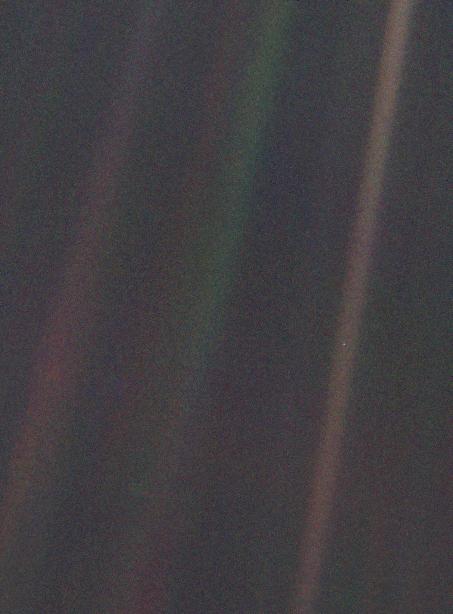
    In 1990, as NASA’s Voyager 1 was leaving our solar system, the late astronomer Carl Sagan suggested that the engineers have the probe turn around and take a picture of Earth.

    Here is the photo of Earth that Voyager took on February 14, 1990:Original caption written by Nasa: This narrow-angle color image of the Earth, dubbed 'Pale Blue Dot', is a part of the first ever 'portrait' of the solar system taken by Voyager 1. The spacecraft acquired a total of 60 frames for a mosaic of the solar system from a distance of more than 4 billion miles from Earth and about 32 degrees above the ecliptic. From Voyager's great distance Earth is a mere point of light, less than the size of a picture element even in the narrow-angle camera. Earth was a crescent only 0.12 pixel in size. Coincidentally, Earth lies right in the center of one of the scattered light rays resulting from taking the image so close to the sun. This blown-up image of the Earth was taken through three color filters -- violet, blue and green -- and recombined to produce the color image. The background features in the image are artifacts resulting from the magnification.

    This was the best and most illuminating selfie ever taken. Not because it shows the Earth in all its close-up glory, but because of its wise and humble perspective.

    Carl Sagan’s Pale Blue Dot speech, inspired by that photo, comes from his 1994 book, Pale Blue Dot.

    The speech is under four minutes long, read aloud. A YouTube video of that is profound.

    Here are the words:

    Look again at that dot. That’s here. That’s home. That’s us. On it everyone you love, everyone you know, everyone you ever heard of, every human being who ever was, lived out their lives. The aggregate of our joy and suffering, thousands of confident religions, ideologies, and economic doctrines, every hunter and forager, every hero and coward, every creator and destroyer of civilization, every king and peasant, every young couple in love, every mother and father, hopeful child, inventor and explorer, every teacher of morals, every corrupt politician, every “superstar,” every “supreme leader,” every saint and sinner in the history of our species lived there–on a mote of dust suspended in a sunbeam.


    The Earth is a very small stage in a vast cosmic arena. Think of the rivers of blood spilled by all those generals and emperors so that, in glory and triumph, they could become the momentary masters of a fraction of a dot. Think of the endless cruelties visited by the inhabitants of one corner of this pixel on the scarcely distinguishable inhabitants of some other corner, how frequent their misunderstandings, how eager they are to kill one another, how fervent their hatreds.


    Our posturings, our imagined self-importance, the delusion that we have some privileged position in the Universe, are challenged by this point of pale light. Our planet is a lonely speck in the great enveloping cosmic dark. In our obscurity, in all this vastness, there is no hint that help will come from elsewhere to save us from ourselves.


    The Earth is the only world known so far to harbor life. There is nowhere else, at least in the near future, to which our species could migrate. Visit, yes. Settle, not yet. Like it or not, for the moment the Earth is where we make our stand.


    It has been said that astronomy is a humbling and character-building experience. There is perhaps no better demonstration of the folly of human conceits than this distant image of our tiny world. To me, it underscores our responsibility to deal more kindly with one another, and to preserve and cherish the pale blue dot, the only home we’ve ever known.


    –Carl Sagan, Pale Blue Dot, 1994

    So many of us are living our lives as if we’ve missed the cosmic memo. The memo tells us that the atoms in our bodies come from the stars, that Earth is all we have and all we know, that our time here is finite, and that to be in awe is not to be on the fringe of life, but it is to capture the meaning of life.

    I got the memo at a young age, which is why I chose to minor in physics. Today for some reason, I needed a reminder. Maybe you did, too.

    More courtesy of NASA and the Jet Propulsion Lab.

  • You can afford it, you just choose not to

    In your mind or in your spoken word . .

    . . . What if the next time you found yourself saying, “I can’t afford _X_,” you stopped and said instead, “I choose not to afford _X_, because I value _Y_ more … ?”

    . . . What if the next time you said, “I don’t have time for _X_,” you said instead, “I choose not to make time for _X_, because _Y_ is more important?”

    What are your X’s and Y’s?
    How do your priorities align with your values?
    Where do you find yourself nodding in agreement?
    Where are you getting defensive?
    What if you accepted full control over how you spend your resources and your time?
    What if you radically owned your own choices, past to present to future?
    What if you realized that it has always been up to you, and it still is?

  • Should you really just “be yourself?” Will you be fine? Really?

    Just be yourself!

    Just be yourself and you’ll be fine!

    What do you make of these platitudes in the workplace?

    It gets confusing when we start to conflate being with doing. They are different things, but each informs the other.

    “Nobody wants to see your true self,” Adam Grant writes in the New York Times. “We all have thoughts and feelings that we believe are fundamental to our lives, but that are better left unspoken.” He concludes that people want you to be sincere, not necessarily, yourself.

    Authenticity and vulnerability guru Brené Brown counters, via LinkedIn, “We are sick of the hustle and the bullshit and the fakery. We are tired of trying to live up to impossible ideals, and we’re no longer willing to orphan important parts of ourselves to achieve success. Most of us will take messy and real over pretending and people-pleasing every time.”

    Here’s what I think: They’re both right.

    “Be yourself” is flawed because it is advice — and all advice is flawed. (Remember that the next time your mother-in-law gives you some and just smile.)

    We are splitting hairs on syntax. The definitions of sincere and authentic are quite similar — they both mean some form of genuine. We are better off when we are genuine people.

    But what’s genuine? What is the self anyway? We each have a multitude of feelings and skills and talents to call upon to serve us in any situation.

    This matters because many of us in the modern economy are in the relationship business, in some form or another. I’ve found that the geekiest technology companies have some of the most authentic employees, simply because they know that to live is to explore and discover. Meanwhile, professional services such as law and medicine, people who are supposed to uphold the title of “expert,” have employees who find it harder to be authentic, where relationships seem more scripted and formulaic. No matter where you work, authenticity can constantly be cultivated.

    Your self is constantly changing. Think back 10 years on some of the stupid shit you said. You’re different now, right? And thank God for that! You have to know your self to fully be yourself, and knowing is a life long journey of discovery.

    To be fully alive as a human is to constantly reinvent, to explore, to act in new ways that challenge us and grow us.

    I’ve switched careers a few times now. From studying and working in computer science in college, migrating over to business journalism and reporting for newspapers and wire services, then climbing the learning curve for Wall Street stock analysis, and I’m now an executive and high-performance professional coach.

    Each role required a different way of acting, and in some times, a different way of being in the world.

    Act your way into a new way of thinking and being,” Herminia Ibarra writes in her book, Working Identity. “You cannot discover yourself by introspection.”

    (Emphasis mine.)

    You discover yourself by doing. Do first. Then be. Then do authentically.

    Wall Street analysts have to market themselves and their research. This means you waltz into a hedge fund office with your laptop with all your spreadsheets, your files, your business cards, your iPad, and sit down in a board room (usually overlooking an amazing view) to meet with fund analysts and managers, talking about your research and answering tough questions.

    My work was high quality, but what did it mean to be myself in that environment? The culture was new. Seven years ago, Wall Street was a totally new environment to me. I grew up a working class Jersey girl — was never rich — and was most recently a business reporter making $50,000 a year.

    But like anything, you adapt, stay curious, and have fun. I made sure I looked the part: $1,000 designer outfit, nice hosiery, stylish flats, hair pressed and neat. Before flying away for a trip, I’d have to clean the dirt out from under my fingernails from my most recent hike.

    Wall Street analysts also have to mingle with industry for research and network with contacts. I attended so many industry conferences — from drones, to electronic warfare, to agricultural equipment, to electric vehicles, to solar power, to geospatial intelligence, to guns. Let’s just say you don’t wear the same outfit when researching the firearms industry as you do when visiting with your hedgie client. You don’t talk about the same topics, unless, of course, they are considering investing in guns.

    Same when covering Tesla. I *got* Elon Musk and his crew, like understood them (I felt) in a deeper way when this light bulb went off: “Oh, they’re just like the geeks I studied physics with in college.” When analyzing $TSLA, I called deeply upon my inner geek to understand the company. When analyzing guns and defense, I called upon my inner freedom badass. When meeting with investor clients, I called upon my inner-loving-reporter-researcher-tired-of-being-broke-self. With my child, I am simply, “Mama,” and that is a world unto itself.

    We are all many selves.

    Ok. So you are reading this blog and you are a multi-talented individual. What does it mean to be yourself? And should you?

    Here’s what I learned: We are always discovering ourselves. Reinvention is the name of the game. And we are at our personal best when we can connect successfully with others.

    That’s all authenticity really is — it is connecting with people as best as you can in the moment. You get there through cultivating your own sense of curiosity and awareness, about yourself and about other people. Authenticity isn’t about your funky socks, or your annoying habit that you defend by saying, ‘that’s just who I am! snort!’, or the streak of pink you just put in your hair (it’s lovely, by the way, by all means, express your style). Authenticity is other focused.

    “Most people associate authenticity with being true to oneself — or “walking the talk.” But there’s a problem with that association; it focuses on how you feel about yourself. Authenticity is actually a relational behavior, not a self-centered one. Meaning that to be truly authentic, you must not only be comfortable with yourself, but must also comfortably connect with others,” says the Harvard Business Review.

    On the Street, the more I admitted to my imperfections, the more I courageously said, “I don’t know,” the more I dialed up the level of service and dialed down any last traces of bullshit, the more clients I gained and the more my research revenue grew. I certainly didn’t do this in direct service to myself, because sometimes, it was vulnerable and embarrassing and I had no idea whether I’d lose the client. I did it because it was the best way to serve the client, even if that meant admitting that perhaps I wasn’t the best person to serve the client in that moment.

    True story: Once, a hedge fund client in San Francisco called and said, “This stock is down 7%. You said it would go up. Why?”

    And I said, “Because Bob, I’m really bad at this job.”

    I was joking, but only a little — several of my stock predictions had gone against me in that time period.

    Later, one of our stock traders pinged me, “What’d you say to Bob!? He just paid us $5,000 in commissions.” And I messaged back, in amazement, “I just told him that I was really bad at picking stocks.”

    Truth and trust are still in short supply in this world. You can exhibit both while still being on a journey of self-discovery and acting different roles.

    If you can offer others a healthy dose of humility and vulnerability, then you’ll form deeper connections.

    But you can’t use “be yourself” to justify being an asshole. That’s just duh.
    (*Name changed)


  • What does self rule mean to you?

    The greatest human experiment in self rule lives another year!

    Government of the people, for the people, and by the people. But do we TRULY mean it?

    What does it mean to you to be sovereign, not a subject? To stand before your god with no man standing between you?

    Happy Independence Day, friends!

    Here’s a fantastic 2004 interview with Michael Novak.

    My fave bit: “Our Founders always wondered about how long it would last. The price of liberty is everlasting vigilance. You’ve got to be on your guard every minute or you will lose it. In most of history, societies have not been free. It’s a very rare society that is free. The default condition of human societies is tyranny. Every society’s inclination is toward tyranny, unless you resist it constantly.”

  • Don’t let unconscious inertia decide for you

    One thing I am loving about coaching is that I get to enter into someone’s life or business as a co-mind on decision points. Coaching helps people not only make better decisions, but also identify when a decision needs to be made, or doesn’t.

    A key question to ask yourself about a certain action is: Am I doing this as a result of a conscious decision? Or is the action the result of unconscious inertia?

    Unconscious inertia is when your actions are the result of not questioning the status quo, or the decision process gets stuck just below the surface of active thinking and awareness.

    Four random examples:

    1.) A small firm has grown to the point where it could justify hiring another employee to share the workload. Hiring the employee would bring more breathing room into the schedules of the principal or owners. However, hiring the employee is risky. What if business trends down? Nobody wants to have to lay someone off. And so, nothing is done.

    But there’s a decision point in there. Maybe, the risk of hiring an employee is too great and you make the decision not to proceed. That’s OK. Or maybe, after some more financial analysis on risk/reward, you feel confident opening the position and seeking the right hire. If I were coaching such a scenario, I’d also gently point out that interviewing candidates is still not hiring them, it’s just exploring a potential future reality and seeing how it sits with you.

    2.) A couple has lived together for seven years — ever since graduating college. They are approaching age 30 and have not married. Days pass and no decision is made. Is it possible to make a decision that takes unconscious inertia and replaces it with decided action? Especially with something as big and sometimes scary as committing to a life partner, you can use smaller decisions to lead to bigger decisions. Maybe you even decide to not decide until a future date. What good does that do? It forces conscious thinking into your actions.

    3.) One of my favorite decisions is choosing to invest in a sabbatical, a period of time to honor one’s life transition and figure out one’s next step. Isn’t that a beautiful decision? You’re not picking your next step, you’re deciding to give yourself time to decide. Then, your days are considered and active. (Plug: A sabbatical is a great time to invest in yourself with a professional coach.)

    4.) You invested in a stock and it’s moved in a particular direction, or has done nothing at all. Do you buy, sell, or hold? Buying or selling are obviously the result of a conscious decision. “Holding” should be, too.  (…Gosh, I love the lessons of the stock market — are they not applicable to life, or what?)

    So long as you’re not causing undue pain to others, there is probably no right or wrong decision.

    Just don’t let unconscious inertia decide for you.


    If you liked this post, you might like:

    Maximize the moment, and jump. A state of uncertainty is nerve-wracking. Nobody likes limbo.
    Forgive yourself for not knowing what you didn’t know before you learned it
    Don’t be paralyzed by imperfection
    Down with gravity; up with entropy!
    The mob asks the wrong questions
    Simple life lesson: Following a leadership pattern
    Five ways to lead a more analytic life
    A paradox of modern life: Comfort is a noose
    Ask not receive not: Advice on questions
    Why the passage of time confounds us
    Applying Wall Street logic to your life
    The double workday, makers and managers

  • Forgive yourself for not knowing what you didn’t know before you learned it

    I have one quote taped to the wall of my office.

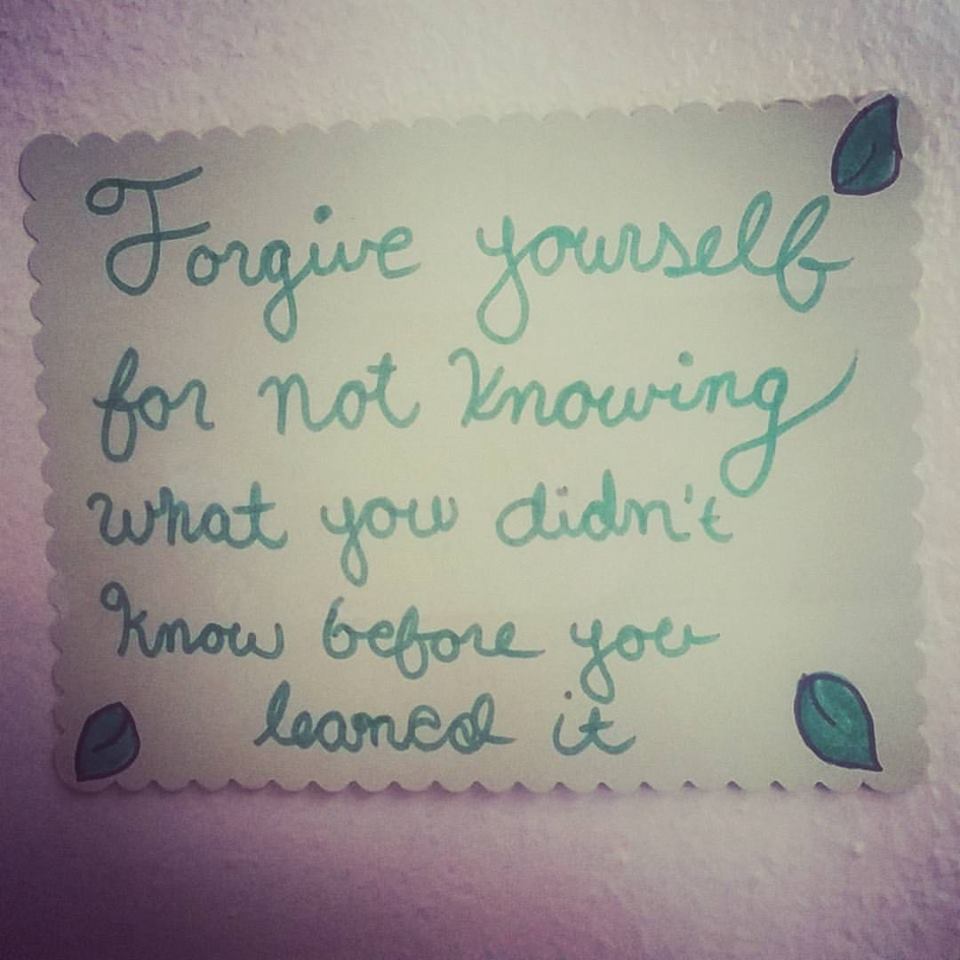
    “Forgive yourself for not knowing what you didn’t know before you learned it.”Forgive yourself for not knowing what you didn't know before your learned it.

    True of stock investing. True of life, too.

    We are all beginners. There is never a time in life when we are not beginners at something. 

    (Aside: I pledged earlier this week to teach myself SnapChat. God help me!)

    Life is giving us an education. We are paying for that education and so are the people we make mistakes on. Yikes. But there is no other way.

    These two stories helped give me perspective over the years:

    One. President George Washington was a successful Revolutionary War commander and most of us know his success story. But, he made many mistakes as a young man in the French and Indian War. Washington’s men paid for his military education with their lives.

    Two. The famous book, “Man’s Search for Meaning,” is written by Viktor Frankl, an Austrian psychiatrist who survived the holocaust and three years in the camps, including Auschwitz. His odds of survival were grim — he was most likely to be killed right away, or worked until the last ounce of his energy had been spent, at which point he’d die of starvation, sickness, or a Nazi guard’s beating. He describes how every decision the prisoner made was a life or death choice. Should one choose this queue or that? He had mere seconds to decide with an incomplete information set. He could march in the direction of a prisoner work hut where he would live, or the gas chamber, where he would die. The lines were not marked. Luck and chance played a role. He could line up in a work group where the guards were in a bad mood and would later shoot him for no reason, or he’d line up with a more merciful guard who might slip a candy bar when no one was looking. These poor souls in the camps were forced to make fateful decisions without being able to see the future or the big picture.

    So, too, are we all making decisions with the best set of data we have. Only, if you’re reading this blog, the consequences for you won’t be nearly so dire, and what a relief.

    Go get ’em, rookie.