the time between the spring and fall equinoxes in the Northern Hemisphere is slightly greater than that between fall and spring, the earth — being at that time closer to the sun — moving about 6 percent faster in January than in July.
I’d always known that the earth is closest to the sun in January and farthest away in July. These points are known as perihelion in January, when the earth is closest to the sun, and aphelion in July, when the earth is farthest from the sun.
(In fact, the seasons are caused by earth’s tilt toward or away from the sun, not the earth’s proximity to the sun. That’s why northern and southern hemispheres have opposing seasons. The official name for earth’s axial tilt of about 23.5 degrees is the “obliquity of the ecliptic.” You can now use this fact to win bar bets.)
Anyway: I somehow managed to get through college physics, and working as an astronomy teaching assistant, without realizing this fact: Winter passes by faster than summer!
Of course, it doesn’t feel that way to me. Probably because summer is filled with sun and fun. How’s that for relativity?
Early on in journalism, one learns the news value of a death. One death in your neighborhood equals 10 deaths in your city, which equals 100 deaths in the U.S., which equals 1,000 deaths in Europe, which equals 10,000 deaths in Africa.
The numbers can vary, but you get the point. It’s a practical rule.
For real life, however, I think the reciprocal is true: One person’s hurt can equal great suffering. If you’ve ever suffered a huge loss, you know what I’m saying. You’ve felt it.
This pearl of wisdom is not my own. I got it from the author Graham Greene. Sometimes, I whip it out when a loved one has shared his or her hurt, and then concludes, “But what right have I to complain? There’s so much greater suffering in the world.”
He writes this:
Suffering is not increased by numbers: one body can contain all the suffering the world can feel.
I first read that line on a flight from Asia back to the United States, in early 2006. I’d bought a copy of Graham Greene’s, “The Quiet American,” from a Vietnamese woman at Hoan Kiem Lake, in Hanoi.
The book remains one of my favorites, for it is filled with life gems like that.
A Buddhist woman prays at Hoan Kiem Lake, in Hanoi, Vietnam. January 2006 | Andrea James
Taken moments ago: A reflection of the plane in the engine.
I used to marvel at how the DMV was the great equalizer — no matter your status, income or personal hygiene, you had to pick a number, buddy, and wait your turn.
Commercial air travel, exceedingly affordable, is quickly taking its place. The realities of the jet age combine the brightest and most-mundane of humanity.
Consider that one of humankind’s greatest achievements — flight, en masse — is met with the guy digging up his nose for gold, two rows back. Great minds have mastered the physics, engineering, manufacturing, economics and piloting on behalf of those of us who have not mastered the use of tissue, ahem.
(I am composing this blog post at cruising altitude, via Delta’s free wi-fi, sponsored by Google Chrome! Sweet!)
Given how easy it is to book a ticket, is it any wonder that the U.S. Transportation Security Administration has enacted its new and intense screening rules? The agency exists to keep travelers safe — and that is what it is trying to do.
I’ve had a lot of time to contemplate these things of late. In the past four weeks, I’ve flown nine times, been naked-scanned twice, received a chest pat once and even received a “special pat down,” for wearing a skirt.
Some of it was slightly embarrassing, but, the TSA folks were courteous and even apologetic.
After the screenings, I tried to muster some outrage of the sort that I’m reading about around the nation: Open declarations that the screenings are unconstitutional. Hilarious mockery from the Canadians. Concern about the feelings of sex-assault victims. The guy who told a TSA worker, “If you touch my junk, I’ll have you arrested.” (The Daily Mail, in the UK, has a photographic summary of the U.S. reaction, including photos of the woman who wore a bikini through the security checkpoint.)
As for me? I’m having trouble getting worked up about it. Every argument I come up with is shot down with two-word rebuttals. Plastic explosives. Underwear bomber. Who knows.
As Jeff Foxworthy would croon, redneck-style, “Well thanks fer spoilin’ it fer evrybody else!”
TSA should be challenged, on a national scale, through the courts. America is stronger for its checks and balances. However, I’m not a fan of the micro-protests, hammering on the people who are just following orders. It’s not “us” travelers against “them” TSA agents. It’s “us” who desire to land after takeoff versus “them” who’d like to kill us.
Up here at cruising altitude, I am secretly glad that everyone went through the same intense security screenings that I did. Even nose picker guy.
Thus, I’ve packed my dignity in my checked luggage. It should meet me upon arrival at the gate.
For a guest lecture once at Pacific Lutheran University, I compiled a list of interviewing techniques for journalism students. The key lesson that topped them all was this:
Do not lie. Be smart enough to figure out how to get the story without deception.
Being upfront has saved me embarrassment many times in my career — whether it’s when an e-mail I wrote was forwarded up some chain and back to my boss, or, whether it was when I found myself questioned by authorities about my intentions.
In each case, I could say that I had honestly represented myself at all times. (Phew!)
Intellectual honesty is a virtue, I think, in any profession. It is particularly necessary for anyone working in the information business, and that’s nearly everyone these days! All we have to go on is our integrity. It’s not worth blowing it, even for a seemingly harmless white lie.
Now: You should have a healthy skepticism of anyone who would blog about how honest he or she is, in life or her job. So, instead of bragging to you about how awesome it is to work honestly, let me tell you about the time I screwed up, and got schooled in front of my peers in this regard.
A typical Saturday morning in the Seattle neighborhood of Queen Anne. (Photo taken in September 2010 by Andrea James)
Did you ever notice that pop culture tends to either scorn or mock the suburb?
The dis-satisfaction of suburban life has been captured with shows such as “Desperate Housewives,” and movies such as “American Beauty.”
The song, “Little Boxes,” sums it up this way: “Little boxes on the hillside, little boxes made of ticky tacky, little boxes, little boxes, little boxes all the same. There’s a green one, and a pink one, and a blue one, and a yellow one, and they’re all made out of ticky tacky and they all look just the same. And the people in the houses all went to the university where they all were put in boxes, little boxes all the same.” (See Pete Seeger perform it here.)
And yet, a majority of Americans choose to live in a suburb — it’s the expected way of life for so many. I spent my high school years in Willingboro, N.J., which is one of the original Levittowns — post-World War II townships of nearly identical home types and curved streets that are divided into neat sections, called parks.
My particular town experienced a white flight in the 1960’s, as blacks from Philadelphia earned enough money to move to the suburbs and somehow settled on Willingboro, thus scaring the whites about falling property values, and the whites moved away. (My family didn’t get the memo, I’m proud to say.) And thus, the town’s racial makeup is now largely black. But it’s still middle class suburb, all the way.
Since becoming an adult, I have chosen to live in cities. It’s been difficult for me to pinpoint why the city is so much more satisfying to me*.
What is it about the city? Why is it that my husband and I pay a premium to fit our lives into 1,000 square feet, when we could trade that in for three times the space farther away?
I’m probably more provincial than any suburbanite: I never leave my Seattle neighborhood, save to go to the airport to travel someplace entirely different. I once joked that I get to Washington, D.C. more often than I get to Seattle’s Ballard neighborhood, which is just a few miles away.
I never have to leave, and I love it. My address has a walkability score of 98. I nearly always am wearing flats and a spring dress or yoga clothes. I walk to church, to the grocery store, to the coffee shop, to the dentist, to Seattle Center, to the park, to the playground, to yoga. My whole life fits into a one-square mile radius. And it’s not boring at all — it’s wholly and completely satisfying.
But, why?
Well, I just picked up a fascinating book, called Suburban Nation, that explains things I’ve often wondered about.
Humanity has for much of its history lived within walking distance of its daily needs. The book differentiates between the “traditional neighborhood,” like the one in which I live, and the suburb, a largely American creation that became popular after World War II.
So here’s my duh realization: Daily life has multiple components: Sleeping, eating, shopping, working and recreation. The suburb serves to separate each of these components via residential subdivision, strip mall, office park and entertainment center. They are each separated by geography, and then connected via feeder roads, making life wholly dependent upon a car.
The design, then, and zoning laws require large parking lots in front of the buildings. The entire landscape is built for cars, not people. You’ll notice that most suburban homes have a driveway that leads to the sidewalk. Whereas, most homes in the city have walkways that go front porch to sidewalk. My Seattle neighborhood is (frustratingly sometimes!) not built for cars — I will often walk two miles rather than give up a coveted parking spot on the street.
Meanwhile, the suburb is “isolation en masse.” This works for a lot of people, particularly those with children*. (I can’t imagine struggling to find for parking, groceries and little tykes in tow. Garage = luxury.)
So that explains it, for me. I love being near lots of people, though I don’ t necessarily always talk with them. I run into people I know as I go about my daily life, and I stop and say hello, and it brings me sheer joy every time. I’m so totally in love with my urban community on the hill.
*I’m writing this while visiting some very close friends, who live in a spacious home in a gorgeous suburb of San Francisco. The lifestyle differences among people don’t make some of us wrong and some of us right, they just make us different. My family still lives in a suburb and thinks I’m crazy for choosing a life of parking hassles and an expensive mortgage relative to the amount of space we get. Still offended? Watch this Sesame Street clip on YouTube.
What do you think? Why do some people pay a premium to live small in the city while others buy giant homes in the ‘burbs?
I was delighted this morning to see this New York Times article on Parisian street artist, JR, who puts up murals of human faces all over the world. (That’s his name, JR — no more, no less. Artists! Sheesh!)
In the Times’s photo gallery slideshow of his artwork, I realized that I had seen his art before, in person, and I hadn’t even realized it!
It doesn’t look that way today. This graffiti artist’s graffiti has been grafittied.
Check out these photos, which I took in November 2009:
Photo of JR's faces, taken in November 2009 in Bethlehem, Palestine. (Photo by Andrea James)Photo of JR's faces, taken in November 2009 in Bethlehem, Palestine. (Photo by Andrea James)
For kicks, here are the rest of my photos from the Palestinian West Bank!
(From the home page, click “read more.” Also, any photo can be enlarged by clicking on it.)
A home along the Mississippi Gulf Coast. The sign says, "Do not allow Katrina to steal your joy." (Photo by Andrea James | September 2005)
I’ve been meaning to write a post about how every day is a special occasion. But every time I begin, I think, what kind of cliche piece of advice is that? Everyone knows that from reading Hallmark “just because” cards.
And yet, I have to remind myself of that often.
In the past, whenever someone gave me perfume or a sweet smelling lotion, I would save it. By the time I was 23, I had amassed a solid collection of lotions and soaps and bubble bath and bath beads and relaxation oils — you’d think that I was obsessed with indulging myself amid the scent of rose and lavender.
And I think that friends and family must have seen my collection and thought, “Wow, she loves Bath & Body Works,” thus creating a multiplier effect on gift occasions.
Once, while helping me to move, my brother-in-law exclaimed, “You and all your bottles!”
At the time, I couldn’t bear to part with even one bottle. I was storing these away for a special occasion. This went on for years.
Then my wedding day came and went. I think I used one of the lotions. Once.
I gave away my collection shortly after.
This upcoming Sunday marks the five-year anniversary of Hurricane Katrina.
I wonder if my newfound penchant for giving things away, and not holding onto too many posessions, comes in part from having lived on the Gulf Coast during the storm. (See my recount in the aftermath, here.)
During that time, I volunteered to help families clean out after their homes flooded. Beloved possessions became soggy stinking junk. Items that may have been saved to honor a special occasion instead became chores — stuff had to be picked up, salvaged or discarded.
It seemed like an enormous and endless task.
I’m eager to read some of the Hurricane Katrina look backs and the where-are-we-now pieces. Particularly from those who have a connection to the Gulf Coast.
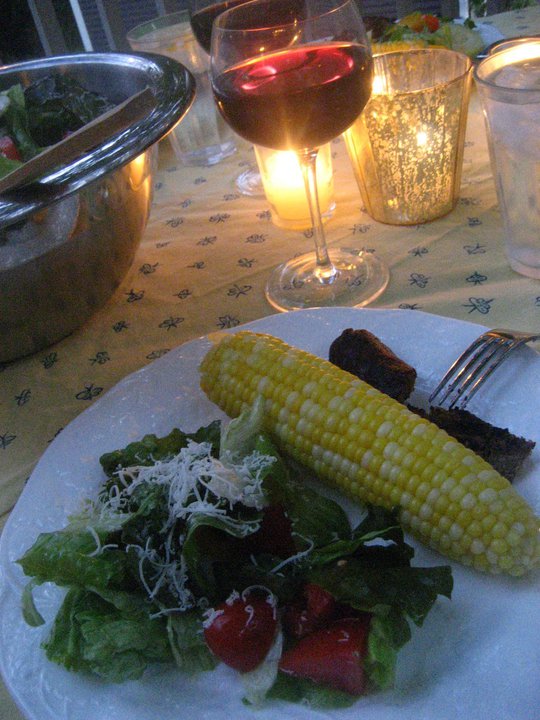
As for how to mark this special-tragic-occasion? I will try to remember that there’s never a better time than now to drink the good wine.
More photos below the jump. Click any photo to enlarge it:
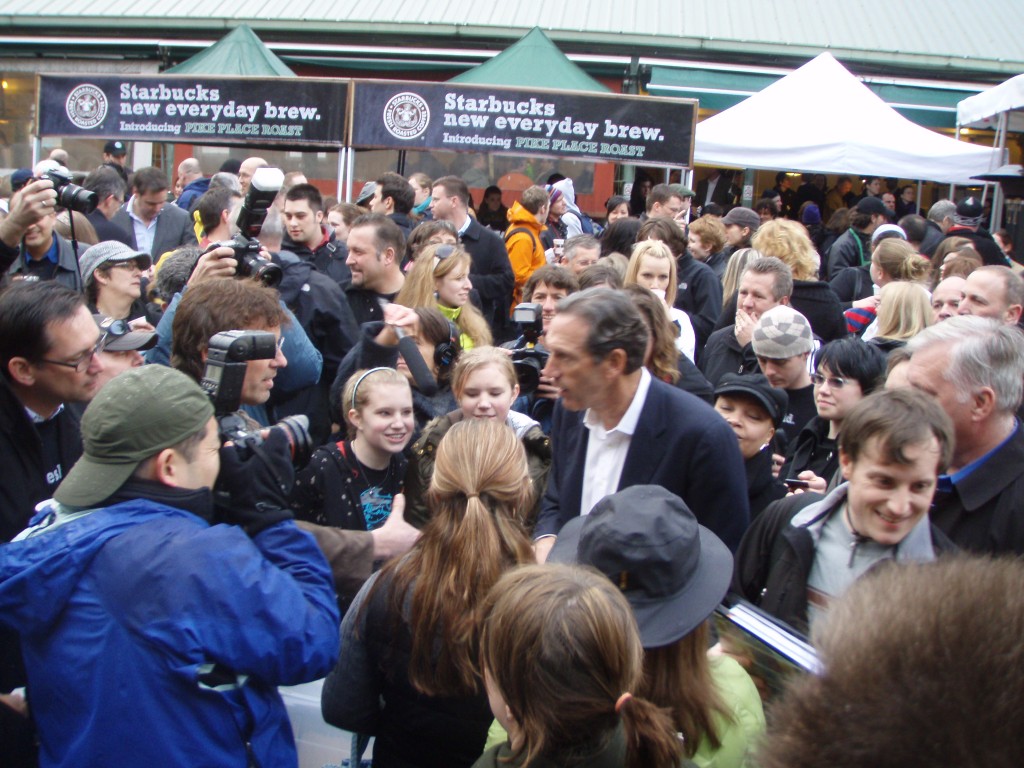
This is me in the crowd at Pike Place Market in 2008, on the day that Starbucks introduced its Pike Place Roast. CEO Howard Schultz is signing autographs in the foreground.
While on a recent business trip, I made some coffee in my hotel using the coffee maker next to the television.
The Starbucks packets seemed designed especially for the hotel brewer. On check out, I braced myself, expecting to be charged something outrageous.
I got my bill and scanned it. “There’s no charge for the coffee on here,” I told the hotel clerk.
“Oh, no charge for that,” he said.
“Wait, so, the coffee is free?” I asked. “But you charge for drinking the bottled water in the fridge?”
“Yes, ma’am.”
My goodness, I thought, in our society, coffee is considered more necessary than water.
The first time that I met Starbucks CEO Howard Schultz, I didn’t know the difference between an espresso and a brew.
And I didn’t even know enough about coffee to know that it was something I should have known.
Maybe it was fitting that as a business reporter, I wasn’t already a fan of the company or its main product. That was more than two years ago. That was before I traded in my daily Diet Cokes for daily coffees.
It occurred to me early on in my career that caffeine was more necessity than luxury if I wanted to make something of myself in modern society. In fact, coffee and tea surged in popularity at the advance of the industrial revolution. (One of the best articles I’ve read on humanity’s dependence upon caffeine is by National Geographic. Check it out here.)
By the time I was a full-time college student, spending long nights writing up physics experiment reports and spending my days working for FDIC in Arlington, Va., I was consuming 32 ounces of regular Coca-Cola per day.
One day, my boss’s boss saw me at my desk with one: My mouth connected to a giant red and white cup via straw. “Do you know how much sugar is in that?” he said. “You’re going to get so fat if you keep drinking that. Switch to diet.”
And, so, I switched to diet. It was difficult at first, because I didn’t like the taste. But then, addiction set in. Diet Coke became “liquid goodness.”
Here I am in Amsterdam in 2007, drinking a "Coca-Cola Light," which is the non-US version of Diet Coke.
I developed a Pavlovian response to the sight of that cold silver can, the feel of its weight in my hands, the cracking sound of the tab — oh, addicts, do you feel me? I would tuck a Diet Coke can behind my feet under my church pew. You’d never find me without a can in my hand. I bonded with news sources over this shared addiction.
Coffee, meanwhile, seemed gross. Who knows what they put in that?
Starbucks taught me exactly what.
Because Starbucks is a brand that must maintain a positive public image, it employs a powerful team of public relations staff. The team struck me as particularly competent at what it did — the staff works hard to educate reporters about the company, and more importantly, about coffee.
I grew up in in a working class New Jersey household. Morning joe meant pouring boiling water over a scoop of Maxwell House instant. My parents kept Sweet’N Low packets in a dish on the table, next to the salt and pepper shakers. And my mother kept a white cannister of saccharin tablets next to her purse, for her morning tea. (As a child, I thought that men drank coffee and women drank tea.)
On a day-long immersion tour of Starbucks, I learned the difference between low-quality robusta and high-quality arabica beans, I saw the labs where the company’s scientists determined which temperatures brought out the best flavors, and I learned about distribution and marketing and product sourcing. (Did you know that the Japanese are the largest consumers of instant coffee? They sell it in machines over there like they do soda here.)
Before that day, I’d thought that coffee beans came brown. I learned that they are plucked off of the trees green and then roasted brown.
For some reason, I’d always thought that coffee was engineered from man-made chemicals. I realized that coffee is as natural as salad. It’s water run through roasted beans. It fit into my decision to make simpler and healthy lifestyle choices.
In October 2009, I officially made the switch to coffee as my main source of caffeine.
I use a French press in the morning. How about you?
This is a question that I rarely ask myself, because I’ve been poking around and asking questions since I was a little kid. And so I know the answer to my original question: People respond, or don’t. You get what you want, or don’t. And life goes on.
Though I’ve made a career switch from journalism to stock analysis, you could say that the essential nature hasn’t changed: I’m a professional questions asker.
Is there a such thing as a stupid question? Yes. When your teacher told you otherwise, he lied.
This is me in front of a restaurant in Bournemouth, England. My married initials are ASK. (My professional and maiden initials are ASJ.)
Stupid questions usually result from not being well-read, not doing one’s homework or not paying attention to your subject. And then there’s the personal prying kind, or the passive aggressive kind — both of which signify that one is in the presence of an ill-mannered dolt. Other stupid questions are the ones where the asker is really trying to show off his or her knowledge, and the question itself is preceded by at least three declarative statements.
There are times when I know my question is about to be stupid. I know that it will totally give away that I haven’t read up on the subject completely. For the sake of time, I usually ask it anyway, with an apology.
Reporters learn an important lesson early on about questions: It’s better to reveal your stupidity to your interview subject than to confirm it for 200,000 people the next morning. (And in the Internet era, your stupidity is confirmed faster, followed by anonymous commenters who don’t let you forget it!)
For the intellectually curious, (which I know you are or why would you be reading my blog?) , questions make life more fun.
For fun, here is my short list of OK to ask questions and NOT OK to ask questions.* Please add your own favorites.