Category: Curiosity

  • Thoughts on suburban life, from an urbanite

    Queen Anne coffee shop
    A typical Saturday morning in the Seattle neighborhood of Queen Anne. (Photo taken in September 2010 by Andrea James)

    Did you ever notice that pop culture tends to either scorn or mock the suburb?

    The dis-satisfaction of suburban life has been captured with shows such as “Desperate Housewives,” and movies such as “American Beauty.”

    The song, “Little Boxes,” sums it up this way: “Little boxes on the hillside, little boxes made of ticky tacky, little boxes, little boxes, little boxes all the same. There’s a green one, and a pink one, and a blue one, and a yellow one, and they’re all made out of ticky tacky and they all look just the same. And the people in the houses all went to the university where they all were put in boxes, little boxes all the same.” (See Pete Seeger perform it here.)

    And yet, a majority of Americans choose to live in a suburb — it’s the expected way of life for so many. I spent my high school years in Willingboro, N.J., which is one of the original Levittowns — post-World War II townships of nearly identical home types and curved streets that are divided into neat sections, called parks.

    My particular town experienced a white flight in the 1960’s, as blacks from Philadelphia earned enough money to move to the suburbs and somehow settled on Willingboro, thus scaring the whites about falling property values, and the whites moved away. (My family didn’t get the memo, I’m proud to say.) And thus, the town’s racial makeup is now largely black. But it’s still middle class suburb, all the way.

    Since becoming an adult, I have chosen to live in cities. It’s been difficult for me to pinpoint why the city is so much more satisfying to me*.

    What is it about the city? Why is it that my husband and I pay a premium to fit our lives into 1,000 square feet, when we could trade that in for three times the space farther away?

    I’m probably more provincial than any suburbanite: I never leave my Seattle neighborhood, save to go to the airport to travel someplace entirely different. I once joked that I get to Washington, D.C. more often than I get to Seattle’s Ballard neighborhood, which is just a few miles away.

    I never have to leave, and I love it. My address has a walkability score of 98. I nearly always am wearing flats and a spring dress or yoga clothes. I walk to church, to the grocery store, to the coffee shop, to the dentist, to Seattle Center, to the park, to the playground, to yoga. My whole life fits into a one-square mile radius. And it’s not boring at all — it’s wholly and completely satisfying.

    But, why?

    Well, I just picked up a fascinating book, called Suburban Nation, that explains things I’ve often wondered about.

    Humanity has for much of its history lived within walking distance of its daily needs. The book differentiates between the “traditional neighborhood,” like the one in which I live, and the suburb, a largely American creation that became popular after World War II.

    So here’s my duh realization: Daily life has multiple components: Sleeping, eating, shopping, working and recreation. The suburb serves to separate each of these components via residential subdivision, strip mall, office park and entertainment center. They are each separated by geography, and then connected via feeder roads, making life wholly dependent upon a car.

    The design, then, and zoning laws require large parking lots in front of the buildings. The entire landscape is built for cars, not people.  You’ll notice that most suburban homes have a driveway that leads to the sidewalk. Whereas, most homes in the city have walkways that go front porch to sidewalk. My Seattle neighborhood is (frustratingly sometimes!) not built for cars — I will often walk two miles rather than give up a coveted parking spot on the street.

    Meanwhile, the suburb is “isolation en masse.” This works for a lot of people, particularly those with children*. (I can’t imagine struggling to find for parking, groceries and little tykes in tow. Garage = luxury.)

    So that explains it, for me. I love being near lots of people, though I don’ t necessarily always talk with them. I run into people I know as I go about my daily life, and I stop and say hello, and it brings me sheer joy every time. I’m so totally in love with my urban community on the hill.

    *I’m writing this while visiting some very close friends, who live in a spacious home in a gorgeous suburb of San Francisco. The lifestyle differences among people don’t make some of us wrong and some of us right, they just make us different. My family still lives in a suburb and thinks I’m crazy for choosing a life of parking hassles and an expensive mortgage relative to the amount of space we get. Still offended? Watch this Sesame Street clip on YouTube.

    What do you think? Why do some people pay a premium to live small in the city while others buy giant homes in the ‘burbs?

  • Maybe you are good at math and never knew it

    I recently attended a personal gathering of relative strangers. We were all friends with the hostess, but didn’t know each other.

    During the get-acquainted phase, one woman said that she is a retired pre-algebra teacher. “Oh!” I said. “I loved pre-algebra.”

    Of course, I took pre-algebra in the eighth grade, after my mother had just died and I had just started school in a new town where, all of a sudden, my vanilla whiteness made me the minority. Compared to the complexities of my pre-teen-angst-ridden life, math (y = mx+b) was elegantly simple.

    I said none of this at the party, and didn’t have time to. Immediately, two other women jumped in with their own stories about how they are not good at math, how they never were, how it pained them so in school and how they have passed their non-matheletic abilities onto their children. “I’ve encouraged my son to go into the arts,” one said, laughing. “He’s just like me – not good at math!”

    What is it about math that people declare, so avidly, that they aren’t good at it? People don’t say it about other subjects, such as reading, do they? That would be embarrassing: “I’m just not good at reading!”  But it is socially acceptable to be lousy at math.

    Maybe we should change that. Not judge people – for sure not! – but, we should recognize that math is as important to everyday life as reading.

    Perhaps, the more nuanced truth is, an individual does not like math, and therefore, does not care to do it or practice it, and is therefore not good at it. Maybe I have some natural ability at math, but more likely, I had no social life as a teen and so I liked math in comparison. (I later went on to be a mathelete – boy was I cool, or what?)

    What comes first? The liking or the doing or the excelling?

    Malcolm Gladwell’s book, Outliers, addresses this concept and challenges the whole notion of innate ability. When you get an early start at something, or like it, you want to do it. The more you want to do it, the better you become and the more you like it. (Gladwell even has a chapter on math, and on how Chinese numbers are easier to say and are more intuitive! For the Chinese, the math and language are tied together. Instead of “thirty-seven” for example, they say “three-tens-seven.” Whereas, in English, in the teens, we have say, fourteen (four-ten), and then in higher numbers, we reverse it: twenty-four, rather than four-twenty. Don’t even get me started on “eleven” and “twelve” – what the heck!? No wonder we get confused!)

    Another friend of mine recently discovered that he is good at math! As a child, his mind would wander and he didn’t pay attention in class. Once, the teacher explained the concepts of “less than” and “greater than” and then set the students about the task of filling in circles with the relevant symbols:  ‘>’ and ‘<.’ My friend realized that he had not been paying attention – again! – and he was afraid to tell the teacher. So, he filled in all the symbols at random.

    The teacher determined that he just didn’t have a brain for numbers.  It was only as an adult that my friend realized that his problem wasn’t his comfort with numbers, it was with his turbo-charged-scattered little boy brain.

    As for me, my ability to do simple mental math has intensified as a stock analyst. I work with a calculator by my side, and I travel with it. When I first started in this job, I would feel slow and lost as people bantered about quickly about effective tax rates, and operating margins and tax-adjusted one-time accounting items. “Whoa!” I thought. “Will I ever be this fast?”

    More than one year later, I can attest: I’m now pretty fast at these simple calculations and getting faster. Thank goodness, the brain is trainable!

    My co-worker and I recently had a similar conversation about whether leadership can be taught. I came up with this analogy: Maybe leadership, or any desirable trait, is like singing. I don’t have the lungs to be an opera singer, but with voice lessons and encouragement, I could solo in the church choir.

    What do you think? Thanks for bearing with me this musing. I did not want to come across as arrogant or offensive, but, I’d like to give people more credit.

    Maybe you, too, are actually good at math!

  • Famous graffiti artist, graffitied

    I was delighted this morning to see this New York Times article on Parisian street artist, JR, who puts up murals of human faces all over the world. (That’s his name, JR — no more, no less. Artists! Sheesh!)

    In the Times’s photo gallery slideshow of his artwork, I realized that I had seen his art before, in person, and I hadn’t even realized it!

    Here is JR’s work in Bethlehem, Palestine, taken in March 2007:  (I do not have permission to post the photo, so please click this link.)

    It doesn’t look that way today. This graffiti artist’s graffiti has been grafittied.

    Check out these photos, which I took in November 2009:

    JR Artwork, Bethlehem
    Photo of JR's faces, taken in November 2009 in Bethlehem, Palestine. (Photo by Andrea James)
    Photo of JR's faces, taken in November 2009 in Bethlehem, Palestine. (Photo by Andrea James)

    For kicks, here are the rest of my photos from the Palestinian West Bank!

    (From the home page, click “read more.” Also, any photo can be enlarged by clicking on it.)

    (more…)

  • How covering Starbucks turned me onto coffee

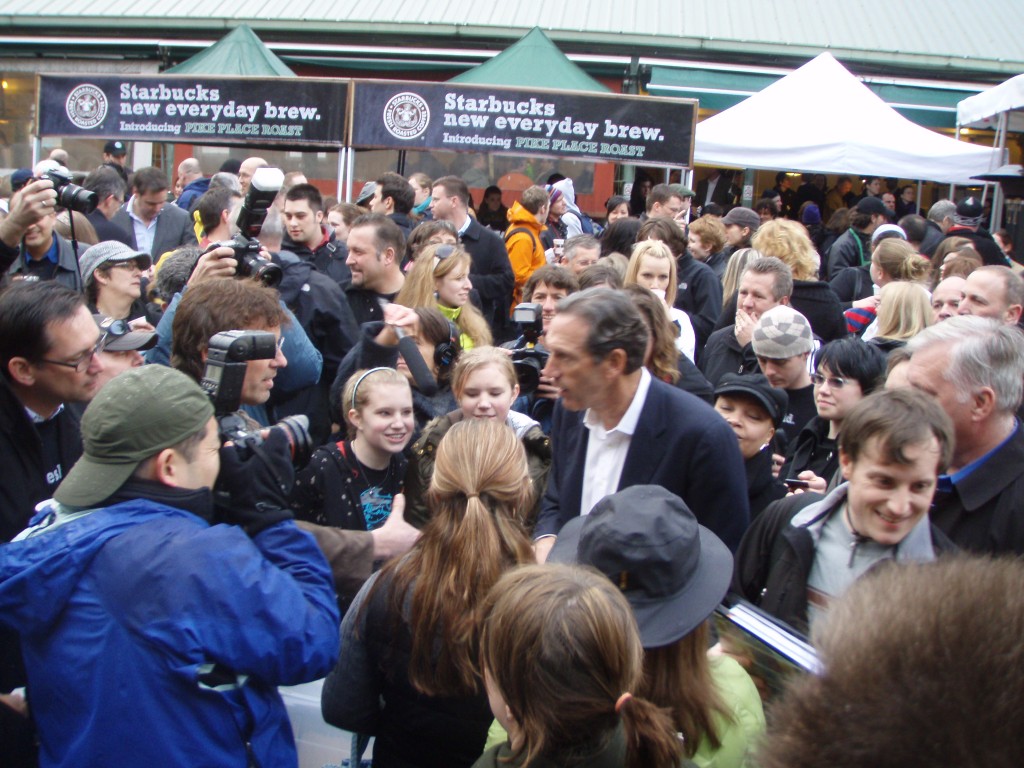
    This is me in the crowd at Pike Place Market in 2008, on the day that Starbucks introduced its Pike Place Roast. CEO Howard Schultz is signing autographs in the foreground.
    This is me in the crowd at Pike Place Market in 2008, on the day that Starbucks introduced its Pike Place Roast. CEO Howard Schultz is signing autographs in the foreground.

    While on a recent business trip, I made some coffee in my hotel using the coffee maker next to the television.

    The Starbucks packets seemed designed especially for the hotel brewer. On check out, I braced myself, expecting to be charged something outrageous.

    I got my bill and scanned it. “There’s no charge for the coffee on here,” I told the hotel clerk.

    “Oh, no charge for that,” he said.

    “Wait, so, the coffee is free?” I asked. “But you charge for drinking the bottled water in the fridge?”

    “Yes, ma’am.”

    My goodness, I thought, in our society, coffee is considered more necessary than water.

    The first time that I met Starbucks CEO Howard Schultz, I didn’t know the difference between an espresso and a brew.

    And I didn’t even know enough about coffee to know that it was something I should have known.

    Maybe it was fitting that as a business reporter, I wasn’t already a fan of the company or its main product. That was more than two years ago. That was before I traded in my daily Diet Cokes for daily coffees.

    It occurred to me early on in my career that caffeine was more necessity than luxury if I wanted to make something of myself in modern society. In fact, coffee and tea surged in popularity at the advance of the industrial revolution. (One of the best articles I’ve read on humanity’s dependence upon caffeine is by National Geographic. Check it out here.)

    By the time I was a full-time college student, spending long nights writing up physics experiment reports and spending my days working for FDIC in Arlington, Va., I was consuming 32 ounces of regular Coca-Cola per day.

    One day, my boss’s boss saw me at my desk with one: My mouth connected to a giant red and white cup via straw. “Do you know how much sugar is in that?” he said. “You’re going to get so fat if you keep drinking that. Switch to diet.”

    And, so, I switched to diet. It was difficult at first, because I didn’t like the taste. But then, addiction set in. Diet Coke became “liquid goodness.”

    Here I am in Amsterdam in 2007, drinking a "Coca-Cola Light," which is the non-US version of Diet Coke.
    Here I am in Amsterdam in 2007, drinking a "Coca-Cola Light," which is the non-US version of Diet Coke.

    I developed a Pavlovian response to the sight of that cold silver can, the feel of its weight in my hands, the cracking sound of the tab — oh, addicts, do you feel me? I would tuck a Diet Coke can behind my feet under my church pew. You’d never find me without a can in my hand. I bonded with news sources over this shared addiction.

    Coffee, meanwhile, seemed gross. Who knows what they put in that?

    Starbucks taught me exactly what.

    Because Starbucks is a brand that must maintain a positive public image, it employs a powerful team of public relations staff. The team struck me as particularly competent at what it did — the staff works hard to educate reporters about the company, and more importantly, about coffee.

    I grew up in in a working class New Jersey household. Morning joe meant pouring boiling water over a scoop of Maxwell House instant. My parents kept Sweet’N Low packets in a dish on the table, next to the salt and pepper shakers. And my mother kept a white cannister of saccharin tablets next to her purse, for her morning tea. (As a child, I thought that men drank coffee and women drank tea.)

    On a day-long immersion tour of Starbucks, I learned the difference between low-quality robusta and high-quality arabica beans, I saw the labs where the company’s scientists determined which temperatures brought out the best flavors, and I learned about distribution and marketing and product sourcing. (Did you know that the Japanese are the largest consumers of instant coffee? They sell it in machines over there like they do soda here.)

    Before that day, I’d thought that coffee beans came brown. I learned that they are plucked off of the trees green and then roasted brown.

    For some reason, I’d always thought that coffee was engineered from man-made chemicals. I realized that coffee is as natural as salad. It’s water run through roasted beans. It fit into my decision to make simpler and healthy lifestyle choices.

    In October 2009, I officially made the switch to coffee as my main source of caffeine.

    I use a French press in the morning. How about you?

  • Down with gravity; Up with entropy!

    I rather like blaming things on the laws of thermodynamics.

    The second law, regarding entropy, is my favorite. It is simple to understand: It states that in any system, anything that happens tends to increase the entropy of the universe.

    This is how I see it: My messy desk is not my fault. The forces of nature and mathematics are working against me.

    Consider this: In the human realm of homes and offices, every object has its place. And there is only one way for each object to be in its place. However, there are  infinite ways for objects to be out of place.

    So, it’s simple probability that things would be out of place. The “proper” way for my keyboard to exist is without crumbs underneath the keys. However, food makes crumbs and I eat at my desk and it only takes one crumb to ruin this proper state.

    Getting something from its chaotic state to its proper state takes energy. It takes work. All of human existence is a constant battle to control nature, to bring elements into their proper places, to maintain our man-made systems, to fight back the chaos and maintain order. Much of our work is either maintaining existing proper states or creating new ones. (What is a smart phone but a collection of properly arranged elements?)

    In the wilderness, the law still applies, but humans don’t try to fight it and so we notice its effect less. Say I moved a rock from here to there in the woods. Have I made the woods more “messy?” No, “messy” is a human construct. Nature is constantly changing and the squirrels don’t need to have all of the woodland objects just so.

    Anyway, I spend great portions of my time either cursing the second law (like when light bulbs burn out or the toilet flush system decays) and thanking it for taking the blame off of me.

    So, I was cheered to see today that the laws of thermodynamics  may be blamed for something else: Gravity.

    It turns out, gravity may not even exist. It may just be a construct of these laws.

    “Differences in entropy can be the driving mechanism behind gravity, that gravity is, as he puts it an ‘entropic force,’” writes the New York Times’ Dennis Overbye, who has the story about Erik Verlinde, a physicist in Amsterdam promoting the new theory.

    Check it out.

  • On War: A Higher Perspective — Part II

    (I write this with full gratitude to the U.S. armed forces, who make it possible for me to sit and ponder such things in peace.)

    I spent hours of my childhood crouched down and hunched over the backyard bugs — so much so that the adults would joke that one day I would be an entomologist.

    Eventually, I chose other professions ending in -ist, but still, the hours I’d spent in a New Jersey suburb, watching the insects, shaped me.

    I would pick up an ant from the red colony and march him to another part of our yard and drop him into the black colony. And he would, inevitably, run away quickly. I’d try to stuff him down the hole — the entry to the ant hill. Usually when I did this, the alien ant would run out a few seconds later. Sometimes, he never made it out.

    My aim was to see if ants from different colonies would assimilate. They would not.

    Many times, I saw rival ant colonies at war. The ants would lock heads with each other and pull back and forth. Eventually, the losing colony soldiers would be outnumbered, fighting one-to-three against the victors. There were dead ants all over the place. A littering of specks amid the grass.

    Death and destruction, right there in my backyard. It was ridiculous and pointless and seemed, to me, a waste of time. Those ants had no idea how small  and insignificant they were.

    Every time I read about the latest warring among our own species, I think of the ants and wonder, “How much wiser are we?”


  • On war: A higher perspective

    In July 2006, I watched on television as the space shuttle Discovery landed. And then, the cameras cut to bombings in Lebanon.

    If I worked for the Intergalactic Press, this would be my brief article:

    Earthlings complete small mission

    A rocket-powered shuttle carrying six humans landed safely on Earth yesterday, to the joy and relief of those in the species who weren’t too busy killing each other to pay attention.

    Carbon-based humans are the most intelligent species to have evolved on Earth, a planet orbiting a non-descript, ordinary star in the hinterlands of the Milky Way galaxy.

    “Intelligence is relative,” said Dr. Eelink Garbold, senior primitive-life studies professor at S2 University in the M51 galaxy. “Earthlings have limited exploration capabilities, but have made dramatic advances in recent decades. However, they peculiarly preserve a warring heritage, similar to other species found on the planet, such as ants.”

    The shuttle spent 13 days off the planet while the humans on board performed what they call “experiments.”

    -###-

  • Ask not, receive not: Advice on questions

    What would happen if you just asked?

    This is a question that I rarely ask myself, because I’ve been poking around and asking questions since I was a little kid. And so I know the answer to my original question: People respond, or don’t. You get what you want, or don’t. And life goes on.

    Though I’ve made a career switch from journalism to stock analysis, you could say that the essential nature hasn’t changed: I’m a professional questions asker.

    Is there a such thing as a stupid question? Yes. When your teacher told you otherwise, he lied.

    This is me in front of a restaurant in Bournemouth, England. My married initials are ASK. (My professional and maiden initials are ASJ.)
    This is me in front of a restaurant in Bournemouth, England. My married initials are ASK. (My professional and maiden initials are ASJ.)

    Stupid questions usually result from not being well-read, not doing one’s homework or not paying attention to your subject. And then there’s the personal prying kind, or the passive aggressive kind — both of which signify that one is in the presence of an ill-mannered dolt. Other stupid questions are the ones where the asker is really trying to show off his or her knowledge, and the question itself is preceded by at least three declarative statements.

    There are times when I know my question is about to be stupid. I know that it will totally give away that I haven’t read up on the subject completely. For the sake of time, I usually ask it anyway, with an apology.

    Reporters learn an important lesson early on about questions: It’s better to reveal your stupidity to your interview subject than to confirm it for 200,000 people the next morning. (And in the Internet era, your stupidity is confirmed faster, followed by anonymous commenters who don’t let you forget it!)

    For the intellectually curious, (which I know you are or why would you be reading my blog?) , questions make life more fun.

    For fun, here is my short list of OK to ask questions and NOT OK to ask questions.* Please add your own favorites.

    (more…)

  • Secondary byline: Bruce Springsteen?

    When I was a reporter, I would try to incorporate Bruce Springsteen’s lyrics into my articles whenever I could.

    Now, I never altered a story to fit the lyrics and out more than 1,000 articles I wrote in my journalism career, it only happened about twice.  One was an article about cities that suffer from brain drain as youth flee to bigger cities in search of education, jobs, opportunities. In that one, I quoted, “Born to run.”

    I also composed many of my articles while listening to Bruce. I’d put on my headphones and make sense of all of my data gathering while jamming away. The music helped me to focus and to feel lighter than I am, which enabled me to think faster and meet deadline.

    Not only do I adore Springsteen’s music, I relate to it. Which creates a deeper connection than simple enjoyment. (My family hails from the same county in New Jersey that he does, and I have cousins who grew up in his hometown. But I think that his fans, no matter where they are from, universally share a connection to his music.)

    Today, I wonder if my affinity for Springsteen’s music had an effect on how my articles shaped themselves. Did it influence me by making me write according to some theme of which I was not consciously aware? Would an analysis of my articles reveal a Springsteen bias?

    New York Times columnist David Brooks, in an editorial that is half reflection-on-life and half ode-to-Springsteen, explores how Springsteen contributed to his non-formal education. He also remarks that our non-formal education contributes more to our happiness than what we learn in the classroom. I encourage you to check it out.