Category: That’s Life

  • Over-communicating is not communicating at all

    A few years ago, our home security provider installed new fire alarm detectors in my house. They emitted loud, high-pitched beeps at even the slightest detection of heat, smoke or steam. Boiling water set off the one in the kitchen. A steamy shower set off the one in the hallway.

    Eventually, we took the batteries out and then switched to a better brand. Later, a security technician told us that lots of people were disabling their fire detectors because the detectors were too sensitive.

    Wow – that’s a huge product failure. In an attempt to keep people safe from fires, the engineers created a product that was actually less effective. The bar to trigger alarm was set too low.

    Communication works the same way.

    Corporate America relies on executive summaries. The intelligence community taught me the concept of BLUF (bottom-line-up-front). Internet culture uses the concept of TL;DR (too long, didn’t read).

    Narrative always has its place. (I started this post in narrative form.) But there is tremendous value in brevity.

    When I was a stock analyst, I often formatted my research into bullet point format, with three categories:

    What’s new

    • One or two sentences on a development.

    What it means

    • Translating those above sentences into easy-to-understand English and adding context and background

    Recommended action

    • Buy, sell or hold

    Once I knew I had an audience who trusted me, I took pride in not wasting their time. There was tremendous value in helping others to tune out noise. There was value in what I didn’t say.

    Time and attention are limited, perishable resources. If you generate too much noise, people will cut you off, filter you away, and tune you out.

    This is true everywhere — at home, in the work place, on Facebook and Twitter. How much is too much? That’s subjective — it’s up to you to know your audience. Maybe you need to communicate more. Maybe less. If no one is opening your emails, or they are missing important information, it’s time to re-calibrate.

    We’re all communicators now.

    Calibrate constantly. Think about your audience. Strive to reduce noise.

  • Taking it down to the science

    Starting in September, I started assisting Tesla with investor communications and therefore have been not blogging as much. For one, my days are full. (I am also still doing executive coaching.) For two, it seems fitting to write less.

    But I did want to share some thoughts as we head into 2017.

    Working at Tesla, you hear the words “first principles” a lot, which has not yet become a widespread business buzzword, but absolutely colors how employees are encouraged to think. Studying Tesla over the years influenced me so much that I named my company, Solve for X Coaching, after this philosophy.

    (Video of Elon Musk talking about the concept is here.)

    It’s a concept based on physics, which means you take things down to the physics and mathematical levels and question all assumptions. Put another way, you ask “why” continuously until you get down to science (or in my view, in the case of life, guidance from religion or philosophy, and even then, you could probably still drill down deeper to the atomic level.)

    It requires that you eliminate thinking by analogy or comparison with known processes. Analogies look at how something else works and then applies that knowledge to the current situation. But the problem with that is that you end up blind to things that could change. Analogies might help in understanding how something works right now, but they don’t help to build something new and better from scratch.

    If you apply this way of thinking to the structure of your own life, sometimes dangerous and miraculous things will happen. Dangerous because it’s hard to maintain the status quo if you’ve questioned everything, miraculous because you discover how much of your own life design is within your own power.

    It’s hard to do it on one’s own, though, with is why I like being a coach and working with people as they lean forward into their own life designs. We all have blind spots, myself as well. I can’t believe how many huge ones I’ve seen in my own life through executive coaching.

    In my own life, when I boil things down to the science, so many of my recent decisions come down to biology and acceptance of that. I have monetary, career, family and motherhood aspirations that often seem to conflict with each other. As a female member of our species with a biologically and psychologically driven desire to reproduce, for instance, I must birth and nurse my offspring and I accept that is a limiting factor on my overall earnings potential. It also defines what I’m solving for now. What I’m solving for in the future will change.

    I accept that my two biggest performance constraints in any corporate environment are 1) my biologically and psychologically driven desire to reproduce and care for offspring and 2) my underdeveloped spatial intelligence, in part caused by nearsightedness and astigmatisms, which make me bad at driving and navigating in any environment. Meh. Luckily, I offer enough strengths to compensate for those two.

    I share this self-analysis because we can all do something similar in our own lives. It’s hard to be bitter when we own our choices and recognize what is outside of our control. (The rules of science are outside of our control.)

    If you are facing conflicting desires or what seems like an unsolvable problem, take it down to first principles, down to the science. Break it all down, nay, wreck it, and build it back up, even if only in your own head. And see what solutions you come up with.

    Happy new year. 🙂

    If you liked this post, you might like:

    You can afford it, you just choose not to
    How a stock analyst looks at housework
    Don’t let unconscious inertia decide for you
    The mob asks the wrong questions
    Can we treat life like an engineering problem?
    Outsourcing versus insourcing your own life
    How a year on Wall Street changed his view
    Sleep deprivation is literally torture
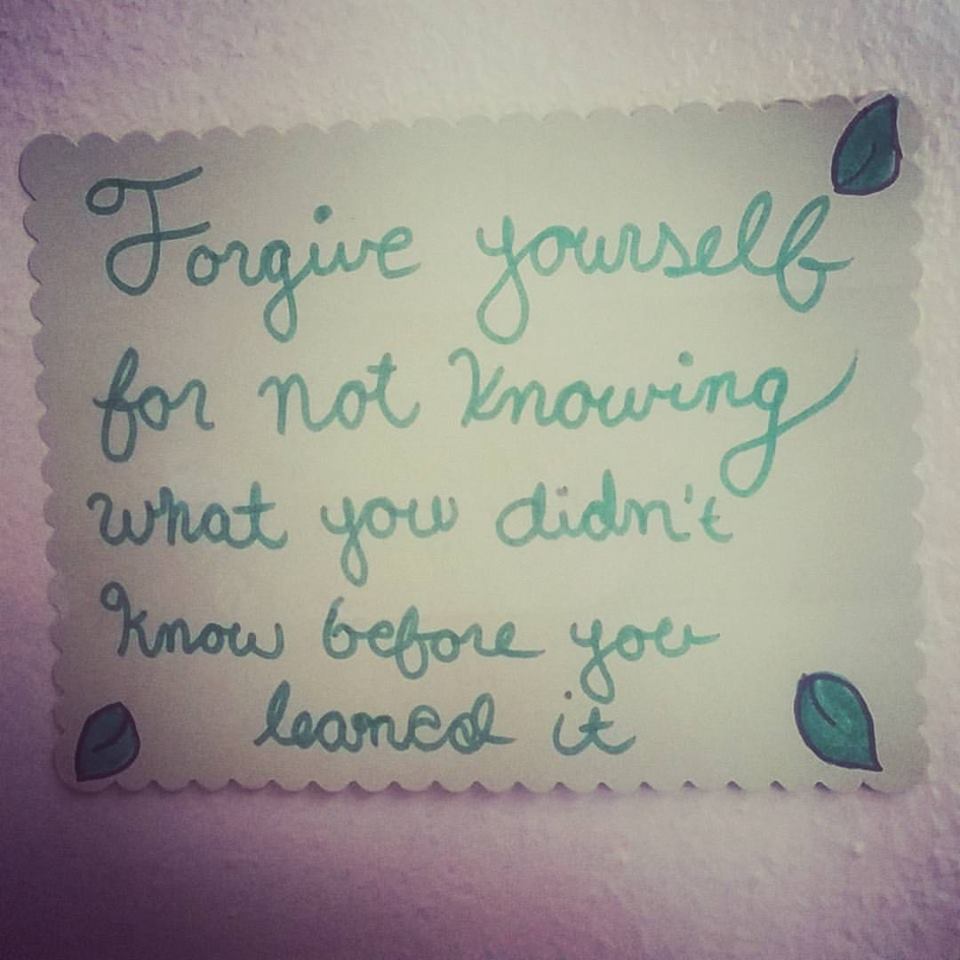
    Forgive yourself for not knowing what you didn’t know before you learned it

  • To be (dumb) or not to be

    The Atlantic has an article, The War on Stupid People, that provides a great starting point for a discussion on innate ability versus hard work. It brings up several thoughts for me.

    One, it’s profoundly difficult to be low IQ in today’s economy. All the low IQ jobs are being outsourced to robots. And to be low IQ is to be mocked. To be medium IQ is to fit in with the majority. To be high IQ is to often feel isolated and to create systems and companies and fill them with one’s own kind.

    Two, what creates IQ? Is it inherited or learned?

    People have value and worth no matter their intelligence level, so how does everyone participate in the economy, and thrive?

    It’s difficult for Americans to realize that we aren’t all equal in terms of ability. We want to believe that anyone can do anything if they just try hard enough.

    I was guilty of “equal thinking” myself when I was younger, looking at peers who could not perform complex math or physics, as I could, and wrongly concluding that they weren’t trying hard enough. Yes, there is something to be said for effort, but there is also natural gifted ability that was not earned, not a factor in human worth or deservingness of good things.

    (My own ‘aha’ that some brains simply cannot do everything well came from taking a hard look at my own poor spatial awareness and sense of direction. This personal mental weakness broadened my empathy for others considerably! My poor spatial awareness means I’ll never make a living driving a car, but we all find different ways to thrive.)

    The Atlantic article posits that not everyone has the mental fortitude to complete four years of university study, and what then? Some human brains cannot do the mental heavy lifting the same way my spindly human fingers cannot grip heavy objects, and no amount of trying is going to alter the underlying biology.

    Inequality of ability leads to inequality of outcome. The really hard part is recognizing that ability is both *inherited* and *cultivated.*

    I think the answer is in helping each unique person discover his or her gifts and strengths, and to play those cards as best as they can. And also helping people to understand that hard work and determined effort can close a lot of the mental gap.

    I also think that mathematical thinking needs to be recognized, early on, as a non-negotiable core strength to be developed and cultivated the same as reading and writing.

    In the end, raw intelligence makes life a lot easier on a person the same way beautiful bodacious breasts make life easier on a woman and having a strong jaw and being tall makes life easier on a man. But inherited traits do not equal self-worth. A person might be a bit dim, but his divine spark shines just as bright.

    This is not meant to be a political discussion – though I can see how it would be interpreted that way – but a personal growth discussion. A chance to deepen one’s personal insight about the economy, ourselves, and our abilities.

    What do you think? What are your natural gifts and how do you play to your strengths? If you happen to be intellectually gifted (probably most of this blog’s targeted audience), what steps can you take to get a bit more humble and empathetic?

  • Forgive yourself for not knowing what you didn’t know before you learned it

    I have one quote taped to the wall of my office.

    “Forgive yourself for not knowing what you didn’t know before you learned it.”Forgive yourself for not knowing what you didn't know before your learned it.

    True of stock investing. True of life, too.

    We are all beginners. There is never a time in life when we are not beginners at something. 

    (Aside: I pledged earlier this week to teach myself SnapChat. God help me!)

    Life is giving us an education. We are paying for that education and so are the people we make mistakes on. Yikes. But there is no other way.

    These two stories helped give me perspective over the years:

    One. President George Washington was a successful Revolutionary War commander and most of us know his success story. But, he made many mistakes as a young man in the French and Indian War. Washington’s men paid for his military education with their lives.

    Two. The famous book, “Man’s Search for Meaning,” is written by Viktor Frankl, an Austrian psychiatrist who survived the holocaust and three years in the camps, including Auschwitz. His odds of survival were grim — he was most likely to be killed right away, or worked until the last ounce of his energy had been spent, at which point he’d die of starvation, sickness, or a Nazi guard’s beating. He describes how every decision the prisoner made was a life or death choice. Should one choose this queue or that? He had mere seconds to decide with an incomplete information set. He could march in the direction of a prisoner work hut where he would live, or the gas chamber, where he would die. The lines were not marked. Luck and chance played a role. He could line up in a work group where the guards were in a bad mood and would later shoot him for no reason, or he’d line up with a more merciful guard who might slip a candy bar when no one was looking. These poor souls in the camps were forced to make fateful decisions without being able to see the future or the big picture.

    So, too, are we all making decisions with the best set of data we have. Only, if you’re reading this blog, the consequences for you won’t be nearly so dire, and what a relief.

    Go get ’em, rookie.

  • Sleep deprivation is literally torture

    Dear fellow biological organisms,

    I am going to advocate for your sleep hygiene because sleep won’t advocate for itself. Rest is often the thing that gets squeezed at both ends when other things should be cut out instead.

    Consider this: When the biological organisms over at the US Central Intelligence Agency want to break down, disorient, and psychologically rewire another biological organism who may wish to do harm, they sleep deprive the subject. They call this “enhanced interrogation techniques.

    When American doctors, nurses, financiers, managers, and parents of newborns want to make a difference, complete their work, or be perceived as competent, we often sleep deprive ourselves. We call this doing our jobs.

    With the exception of parents of newborns (sorry man, nature is cruel), you don’t have to accept culturally imposed poor sleep hygiene. Even better, if you are an organization’s leader, you can set the tone from the top.

    Sleep gets squeezed in business all the time. And we tell ourselves that this time is worth it. That this particular business trip, this particular set of circumstances, this particular deadline or goal, warrants powering through. But, after years of watching it happen over and over, watching people run themselves ragged and gain weight, I’ve come to the conclusion that we all need to be reminded constantly that we’re not robots.

    Last year, BMW’s CEO collapsed on stage during a press conference at the Frankfurt Motor Show. The stated cause? Fatigue.

    The problem is that sleep deprivation disrupts our circadian rhythms and leads to poorer brain performance. Working long hours even causes us to be negatively biased and less happy.

    When I travel with executives around a city for investor client meetings, there is a lot of pressure to fit in as many meetings as possible, sometimes even skipping lunch or having the C-level officer eat during his presentation. I always disliked this and tried to carve out time for the executive to eat in peace or have downtime. My reasons were both caring for the individual, but also selfish: When I had a “buy” rating on a stock, I wanted the executive to put his best foot forward to instill confidence in new investors. Running ragged helps nobody.

    When my team created a schedule, I would point out repeatedly, “We are biological organisms. We are biological organisms.”

    The people who stood out to me — and they were nearly always star performers — were the ones who did advocate for their own downtime and time to sleep. It often came across as IDGAF, but, it worked.

    And yet, I so often failed to adhere to my own advice. The national live television appearances I regret were the ones I did when I was not well rested. I cringe to watch myself on CNBC after I didn’t get a full night’s sleep.

    No matter your job title, your primary means of making an income involve your self and your brain. Your brain needs sleep to function well. You are a brain-athlete. (In high school, I was a mathlete who competed in math competitions. Picture me intimidatingly lifting my graphing calculator and flexing my biceps.)

    You can read a ton more about this — scientific proof of the need for sleep is everywhere. And questions about why we must deal with biological limits are better left to philosophy and religion.

    In conclusion, this post is not about being a wuss. It’s not about a 35-hour work week or arbitrary numbers. I love our culture of achievement and git-er-done. But, it is fundamentally unintelligent to ignore our own biology.

    We should conduct business in a way that optimizes performance. What can you cut out besides sleep?

    Get some sleep.

    Supporting research links:

    Why sleep deprivation is torture (Psychology Today)
    How the CIA tortured its detainees (The Guardian)
    Sleep deficit: The performance killer (Harvard Business Review)
    Sleep is more important than food (Harvard Business Review)
    There’s a proven link between effective leadership and getting enough sleep (Harvard Business Review)
    BMW chief’s collapse highlights executive stress (CNBC)


  • A new twist on the bucket list

    Do you have a bucket list? That is, a list of things you’d like to accomplish before you kick the bucket?

    I never created one for myself — the truth is, my reverse-bucket-list is a lot more spectacular than any list I would’ve come up with 10 years ago. A reverse-bucket-list names what you’ve already experienced or accomplished. (If you’re curious, my list is here.)

    It’s a fun list. And I imagine many people reading this blog would list incredible things about themselves. Things that I’d love to hear you tell me about over a drink or coffee. Experiences made possible by expanded opportunities for women and minorities and commoditized air travel, things that folks born two generations ago might not have imagined. (My father, born in 1921, did see much of the world during World War II, though it was via Navy submarine and it wasn’t a pleasure trip. My mother barely left the tri-state area.)

    The next step, my goal for 2012, is not to necessarily to have more adventures. (Though, I’d rarely turn one down.) The next step is to foster something that a fast-paced lifestyle, born out in a digital age, has made scarce: Community.

    Rather than using my spare resources (ie: money and time) to stack up concert tickets and passport stamps and fitness goals like poker chips, my goal is to strive for more in-person connection. To savor face-to-face conversations and tactile shared experiences.

    I think we could all use a little more community.

    Wishing you many blessings in 2012.

    (more…)

  • We love consistency but need change: Voila, the seasons

    My old alarm clock went off this morning before my mobile phone did. That’s odd, I thought as I scrambled over to shut the thing up.

    The dumb alarm clock — as in, not smart like my phone — is the backup alarm, the one that will faithfully and annoyingly beep at me at 3:30 a.m. no matter what, and has zero risk of downloading a faulty software upgrade at midnight.

    Why didn’t my mobile phone wake me first, as it was programmed to? And then I realized: It’s an hour earlier than I thought. My mobile phone knew that today was time change day. And so did all of my laptops.

    I was left to marvel at two things.

    1) My time-keeping technology can be broken down into smart and dumb depending upon whether they know to adjust the time. (Darn you microwave!)

    2) Does it amaze you that nearly all of American society adjusts the time by one hour twice per year? And the fact that a couple of states have chosen to opt out makes it even more hilarious.

    Can you imagine how this would appear to an outsider? Humans are such kooks.

    It’s kind of whimsical though — so much of America has been homogenized for maximum efficiency. This is a ridiculous tradition that continues because we lack the ability to fight the inertia to change it.

    Season changes are delightful. The time change is silly, but somewhat delightful in its whimsy — an aberration more reliable than a snow day. They remind me of this passage from C.S. Lewis’s “The Screwtape Letters.”

    Here, one of the devil’s minions is educating a junior minion about human kind. Their purpose is to destroy joy and promote anguish, but to do so, the junior minion must first understand how humans are created. In the context of this book, “the Enemy” is God.

    The horror of the Same Old Thing is one of the most valuable passions we have produced in the human heart — an endless source of heresies in religion, folly in counsel, infidelity in marriage, and inconstancy in friendship. The humans live in time, and experience reality successively. To experience much of it, therefore, they must experience many different things; in other words, they must experience change. And since they need change, the Enemy (being a hedonist at heart) has made change pleasurable to them, just as He has made eating pleasurable. But since He does not wish them to make change, any more than eating, an end it itself, He has balanced the love of change in them by a love of permanence. He has contrived to gratify both tastes together in the very world He has made, by that union of change and permanence which we call Rhythm. He gives them the seasons, each season different yet every year the same, so that spring is always felt as a novelty yet always as the recurrence of an immemorial theme.

    . . . If we neglect our duty, men will not be only contented but transported by the mixed novelty and familiarity of snowdrops this January, sunrise this morning, plum pudding this Christmas. Children, until we have taught them better, will be perfectly happy with a seasonal round of games in which conkers succeed hopscotch as regularly as autumn follows summer.

    May we never get so tired of life that the seasonal changes fail to delight us.

    Organic pumpkin farmOrganic pumpkin farmCupcake Royale in BallardLost in the leaves
    (This post is filled with photos taken by me in the past month in Seattle and its environs. Click any photo to see a larger version.)

    (more…)

  • Lucky seven billion — now what?

    In case you haven’t heard, the United Nations is saying that the world population will reach 7 billion today.

    Happy Halloween?

    Of course, the number and date are symbolic rough estimates, since there’s no way to count everyone on the planet down to the person. The UN is using the figure to create a news event, or call to action, for fighting global injustices. (More.)

    I’m wondering, what the heck are the rest of us supposed to do with this information? Worry? Duly note it?

    Tuck it away for sarcasm purposes later?

    “Seven billion people on the planet and I’m the one who (insert unique problem and eye roll here.)”

    (Whatever you do, from this day forward, do not get caught saying “six billion people” — you will look woefully behind the times.)

    Does population matter? Is the Earth over populated? How would you even talk about such a thing from a religious world view?

    Population is the unspeakable missing factor in a lot of dinner party discussion topics — the consumption society, rising global living standards, immigration, the state of U.S. education, anthropomorphic climate change, agricultural progress and food shortages, liberal versus conservative world views. (What’s that? You stick to sports and movies? Need to try that!)

    Maybe polite company could discuss population growth, but who wants to be the first to go all Ebenezer Scrooge on the party, talking about decreasing the surplus population? The closest thing I ever hear to the “too many people” assertion is usually regarding California highway traffic.

    Population discussions are uncomfortable. They go straight to the heart of the debate over individual versus collective freedom.

    If “7 billion” as a news topic makes you uncomfortable, you’re not alone.

    Bill Gates intellectually struggled with the idea of overpopulation in relation to the work of The Bill and Melinda Gates Foundation, which promotes programs that improve health care and lengthen life. He knew that improving health was good on an individual level, but what about on a collective, global level? Gates has said that he was relieved to learn that better health leads to economic improvement, which eventually leads to lower natural birth rates.

    “I believe it is in the rich world’s enlightened self-interest to continue investing in foreign aid. If societies can’t provide for people’s basic health, if they can’t feed and educate people, then their populations and problems will grow and the world will be a less stable place,” Gates said in his 2011 annual letter. “. . . The second great benefit of vaccination is that as the childhood death rate is reduced, within 10 to 20 years this reduction is strongly associated with families choosing to have fewer children. While it might seem logical that saving children’s lives will cause overpopulation, the opposite is true. I mention this amazing connection often, since I remember how I had to hear it multiple times before the full implications of it became clear. It is the reason why childhood health issues are key to so many other issues, including having resources for education, providing enough jobs, and not destroying the environment. Only when Melinda and I understood this connection did we make the full commitment to health issues, especially vaccination.”

    He’s definitely treading on some controversial territory there, but I believe he presents his arguments in a scientifically compassionate way.

    American author Jonathan Franzen addresses the topic of population control in his hit novel, “Freedom.” Two of the main characters — portrayed as liberals harboring excessive guilt over their own existence — adopt human population control as one of their secret pet causes, and find themselves slipping down a rabbit hole of ever-more absurd theories and slogans. Those bits make up some of the most awkward and infuriating sections of the book — if it was the author’s intent to make the reader gnash one’s teeth, he achieved it.

    I’ll conclude this blog post the way many debates end in Paris: With the existential question about why we’re even debating it in the first place.

    From Adam Gopnik’s, ever-quotable, “Paris to the Moon”:

    In Paris explanations come in a predictable sequence, no matter what is being explained. First comes the explantion in terms of the unique romantic individual, then the explation in terms of ideological absolutes, and then the explanation in terms of the futulity of all explanation.

    Population talk falls within all three paradigms.

    Don’t just be one of the crowd, please feel free to share your thoughts. 🙂

    (more…)

  • Play to win: Airport security tips down to a science

    Business travel is both exhausting and exciting. I love arriving at a new destination and switching “on.” But getting there? Oy.

    Like most things, you get better with practice.

    Here is my system for getting through airport security as quickly and as least-disgustingly as possible.

    This assumes a full-sized carry on suitcase and a laptop or tablet bag.

    -3.) Before you go: Wear as few metal accessories as possible. FYI: Five or more bobby pins in your hair will set off the detector. No water bottles.

    -2.) In the security line, get your ID and boarding pass ready. Turn your ID and boarding pass all the same way so that it faces the TSA agent. Plop both onto his podium. Wait patiently while the agent makes incantations with a marker and a magic flashlight. If you’re using your cell phone to check in with the infra-red scanner, be ready with self-effacing apologetic jokes about the wonders of technology. You’ll need to appease those behind you in the line, as it will take about 17 scans and lots of nervous laughter before it works.

    -1.) Make faces at the agent that match your ID photo. Hopefully, you’re not scowling on your license. After the first TSA agent has scanned your ID and graffitied your boarding pass, put both of those away so you don’t have to worry about them.

    0) Mentally prepare for the next step. This is a contest with the universe that you intend to win. No second must be wasted! Don’t move frantically through these next steps. Move methodically. You don’t need to make a show of going fast to benefit the person behind you. Who cares what he thinks? Little does he know, you’ve got a system. (Corollary: If the person behind you at all huffs or acts impatient, you now have my permission to switch to tortoise mode, the more comically exaggerated the better. Been there, done that and wished the guy a nice flight after TSA held him back for his improperly placed liquids. Shoulda slowed down and got it right the first time, buddy.)

    1.) When you are within grabbing distance of the gray bins, pick up three. Or if you feel like people are crowding you, grab five and just leave the last two empty. It will give you space to work. Announce knowingly to no one in particular, “I need lots of bins.”

    Lay out all three bins. Make a big determined show of having a system so that everyone around you leaves you alone. You’re not here to make friends.

    Leave the first bin empty for now. That’s your strategic bin.

    2.) Place your laptop or tablet bag between bins two and three. Extract your laptop or tablet and put it in bin two.

    3.) Heft your suitcase up onto the metal table and put it behind the third bin, with the zippers facing you. Using two hands, unzip both ways. Extract your liquids baggie and place it in the third bin. Re-zip the suitcase. Use both hands like the ambidextrous champ that you are.

    4.) Now your public disrobing begins. (KEEP your shoes on! Don’t get ahead of me! The less time you stand there in your stocking feet on the dirty floor, the better!) Begin to remove your accessories — watch, belt, wedding ring — as you push your bins toward the scanner. Put the accessories in the first bin or in a round dish.

    5.) Take off your jacket. Throw it over your laptop, which is the second bin. Loosen your shoes. Better yet, wear slip-ons.

    6.) Once you’re nearly to the metal detector, pop off your shoes and put them in the first bin, next to your accessories.

    7.) Push all of your bins and your bags onto the conveyor belt. Once your suitcase (the caboose in your train) is on the conveyor belt, turn to the front. Make eye contact with the TSA agent. He’ll wave you through the metal detector. Walk through seamlessly, head high, like the obedient upstanding flyer you are. After your beepless pass-through, smile at the TSA agent and thank him. (It’s a thankless job.)

    8.) Time to reclaim your belongings and dignity. Grab your shoes out of the first bin. They will come through quickly because scanning them only takes a second. Put on your shoes. Put on your watch. Put on your wedding ring.

    9.) Your jacket and laptop will emerge next in bin number two. At this point, the TSA agent will be looking at your suitcase through an x-ray machine, zip-zipping it back and forth, trying to ensure that your curling iron is not a bomb. That delay will give you time to put on your jacket and put your laptop away. Then, sling the laptop bag over your shoulder.

    10.) Your liquids will emerge next in the third bin. Grab them with your left hand.

    11.) Finally, your suitcase emerges. Grab that with your right hand. Make your way to one of the tables. (Most airports have those now, for convenience. It took them long enough!) Put your liquids away.

    12.) Cell phone? Check.
    Wedding ring? Check.
    Laptop? Check.
    Wallet? Check.
    Carry-on? Check.
    Jacket? Check.
    Shoes tied, buckled, zipped? Check.
    ID? Check.
    Zipper on your fly? Never hurts to check.
    Boarding pass? Crap, where is that again? Check.

    Quick area scan – anything yours on the ground? The table?

    Congratulations. You’re off to Hudson News and then onto your gate!

    Your tips and stories are MORE than welcome!
    (more…)
  • Simple life lessons: Following a leadership pattern

    It’s not easy being out in front.

    I first learned this when I did investigative reporting. Even though I knew my information was sound and that my story was true, I got a nervous feeling in my stomach the night before the newspaper published a scoop. Because I knew that no one else had the information, I knew that it would surprise people, I knew humanity’s tendency to blame the messenger, and I knew that extra attention can be exciting but it is also deeply stressful.

    The thing is though, someone has got to lead. Why not me? Why not you? Why not my company? Why not yours?

    But there’s truth to the other side too — someone has got to follow. And there can be honor in following. A considered life will have periods of both.

    Three kitchen-table anecdotes illustrate my point:

    • 1) Ice Cream Shop

    Opening up an ice cream shop in my neighborhood seems like a no-brainer strategy. My neighborhood is filled with kids and playgrounds and affluent families.  And yet, we didn’t have an ice cream shop for years.

    Last year, Menchies opened a buffet-style frozen yogurt shop on the main thoroughfare. The place is crowded day and night. That was smart. Why didn’t anyone think of it sooner?

    This year, Molly Moon’s opened another ice cream shop, blocks away.

    Now I’m thinking the market might be saturated. But hat’s off to the two businesses that had the idea first. They’re already capturing some of my dollars.

    Lesson: Just because no one else has done it before doesn’t mean it’s a bad idea and won’t work. It may just mean that no one else has had the moxie to try.

    • 2) The Highway

    Recently, I was driving on a three-lane highway, heading for Detroit airport. I had six miles to go until the turn-off to drop off my rental car.

    The speed limit was 75. I noticed that the left two lanes were empty, but there was a line of cars doing 60 miles per hour in the right-most lane.

    Wow. Talk about a bunch of lazy followers! I decided to join them.

    For me, it was one of those rare instances when I wasn’t in a rush, and so I decided to blast my radio and get in line. So long as I maintained a safe distance from the car in front, I didn’t have to really think. It was so easy – I didn’t have to monitor my speed, merge lanes, time my lane shift, pass with care – less thinking, more singing to the radio.

    Lesson: People follow for different reasons, and sometimes, it’s nice to get in line and do your part.

    • 3) The Airport

    This continues from the last story. I finally got to the security check point and there was a huge, messy line that was longer than the lanes delineated by the retractable tape barriers.

    Photo from inside Detroit Airport, showing a fountain and a 747 airplane.
    A view from inside Detroit Airport (DTW).

    And there was a sign that announced: “Additional security check point up one level.”

    About three feet to my left was the escalator. I thought, “That entrance is probably stuffed too. And if I leave to go look, I’ll lose my spot.”

    Then, remembering back to all of us sheeple in the highway lanes, I decide to check it out.

    No lie: There were only about five people in the line immediately up the stairs. All this time opportunity, and people were not seizing upon it!

    Lesson: I work with stocks. This to me is symbolic of how markets are not always perfectly efficient — there is opportunity out there, if you think to seize it. But, it carries risk. Same with life. While forging ahead, you could lose your place in the line. But, the line will always be there waiting to take you back – so why not try?

    (more…)