I bought some five-finger minimalist running shoes. My goodness they are ugly.
Looking down at my new Vibram five-finger running shoes.
Have you ever seen anyone wearing these? It’s a startling realization when you do.
A family member of mine wore them all around Ireland on my recent vacation. Every time I saw his feet poking out from beneath his jeans, I nearly screamed of fright.
Ack! Gorilla feet! It’s just not right, people!
He told me that he loved being able to feel the different textures of the ground as he walked. He was a tourist down to his toes. That’s the first thing that piqued my interest.
And while I wish I could say that ligament health or some technical reason was my final impetus for buying my own five-fingers, the truth is that my favorite method of exercise is running, I travel a lot for work and my bulky Nike sneakers took up too much room in my carry-on suitcase.
My five-fingers came from REI’s Seattle flagship store. The sales staff there knew more about five-fingers than I knew could be known, and helped me to pick out a suitable set.
When I lived down south, I used to run barefoot along the Perdido nature preserve on the Gulf Coast. Those runs were some of the most liberating of my life. Imagine turquoise waves, a white sand beach, Alabama-blue skies, a swamp off to the left with alligators, an oil rig in the distance and virtually zero people.
I’ve captured some of that feeling again. Running with five-fingers is almost like running barefoot on soft sand.
Somewhere along the line, I had become convinced that “ample support” was the most important thing in a running shoe. And, I now believe that is not true.
I never realized how much that big chunk of rubber around my heel — the more the better, I used to think — got in my way. Traditional running sneakers treat your feet and ankles as delicate baby birds, unable to support your body without a protective nest.
But my new shoes have liberated my feet from the sneaker-man, who was keeping them down. My five-fingers have turned my rough and painful slogs up Seattle’s steep hills into a more graceful prance. I feel lighter, bounding upward like a gazelle.
My old alarm clock went off this morning before my mobile phone did. That’s odd, I thought as I scrambled over to shut the thing up.
The dumb alarm clock — as in, not smart like my phone — is the backup alarm, the one that will faithfully and annoyingly beep at me at 3:30 a.m. no matter what, and has zero risk of downloading a faulty software upgrade at midnight.
Why didn’t my mobile phone wake me first, as it was programmed to? And then I realized: It’s an hour earlier than I thought. My mobile phone knew that today was time change day. And so did all of my laptops.
I was left to marvel at two things.
1) My time-keeping technology can be broken down into smart and dumb depending upon whether they know to adjust the time. (Darn you microwave!)
2) Does it amaze you that nearly all of American society adjusts the time by one hour twice per year? And the fact that a couple of states have chosen to opt out makes it even more hilarious.
Can you imagine how this would appear to an outsider? Humans are such kooks.
It’s kind of whimsical though — so much of America has been homogenized for maximum efficiency. This is a ridiculous tradition that continues because we lack the ability to fight the inertia to change it.
Season changes are delightful. The time change is silly, but somewhat delightful in its whimsy — an aberration more reliable than a snow day. They remind me of this passage from C.S. Lewis’s “The Screwtape Letters.”
Here, one of the devil’s minions is educating a junior minion about human kind. Their purpose is to destroy joy and promote anguish, but to do so, the junior minion must first understand how humans are created. In the context of this book, “the Enemy” is God.
The horror of the Same Old Thing is one of the most valuable passions we have produced in the human heart — an endless source of heresies in religion, folly in counsel, infidelity in marriage, and inconstancy in friendship. The humans live in time, and experience reality successively. To experience much of it, therefore, they must experience many different things; in other words, they must experience change. And since they need change, the Enemy (being a hedonist at heart) has made change pleasurable to them, just as He has made eating pleasurable. But since He does not wish them to make change, any more than eating, an end it itself, He has balanced the love of change in them by a love of permanence. He has contrived to gratify both tastes together in the very world He has made, by that union of change and permanence which we call Rhythm. He gives them the seasons, each season different yet every year the same, so that spring is always felt as a novelty yet always as the recurrence of an immemorial theme.
. . . If we neglect our duty, men will not be only contented but transported by the mixed novelty and familiarity of snowdrops this January, sunrise this morning, plum pudding this Christmas. Children, until we have taught them better, will be perfectly happy with a seasonal round of games in which conkers succeed hopscotch as regularly as autumn follows summer.
May we never get so tired of life that the seasonal changes fail to delight us.
(This post is filled with photos taken by me in the past month in Seattle and its environs. Click any photo to see a larger version.)
How droll, I’m going to talk about our soggy weather.
If you’re visiting from outside of Seattle, all you need to know is that it always rains here. Nothing else worth reading. No really, this blog post is super boring.
You may have noticed the big white ball in the Port of Seattle over the past month. It’s easily the most recognizable thing at the Port, outshining the container cranes and the ferries.
The ship is a Sea-Based X-Band Radar Vessel, and it is a sensor for the nation’s Ballistic Missile Defense System.
The vessel is under refurbishment at Vigor Shipyard Seattle. The X-band radar is switched off while the vessel is in port. The radar dome sits atop an oil-drilling platform.
The cool thing is that it arrived in mid-May is expected to be here until mid-August, so it’s almost like it’s a part of Seafair, Seattle’s summer-long festival that celebrates the air and the sea.
When the Boeing-built X-Band Radar is on, the ship system is able to detect hostile missiles, and relay data to interceptor missiles so that the threat can be destroyed. The vessel itself is bigger than a football field and has living quarters on board.
Springtime is trickling into the Pacific Northwest — with sunbursts between raindrops. The days lengthen as sunset arcs toward 10 p.m.
This is me, a budding Seattleite, sunning by the pool on a recent Mexico vacation
I love this time of year. It means summer is coming — and summer in Seattle is a beauty.
But there’s one thing I really miss about summers here:
Pools.
As summer approached as a kid, I would daydream about which pool I wanted to jump into first. I would examine my pool options, imagining the perfect concrete-to-grass-to-foliage ratio. Too many trees make shadows in the pool. Too much concrete makes the pool area uninviting.
The perfect pool experience means a blue pool liner (no cement!), surrounded by white concrete, which is surrounded by green grass, which is surrounded by trees. I liked the shouting and bustling, see-and-be-seen scene, of public pools.
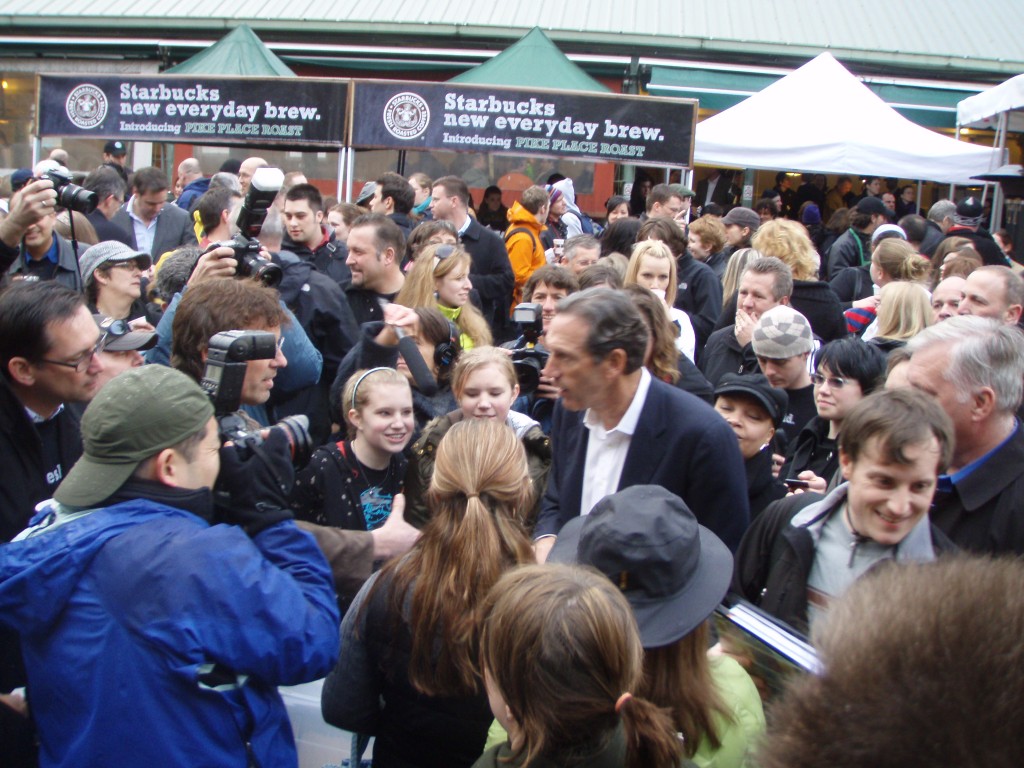
This is me in the crowd at Pike Place Market in 2008, on the day that Starbucks introduced its Pike Place Roast. CEO Howard Schultz is signing autographs in the foreground.
While on a recent business trip, I made some coffee in my hotel using the coffee maker next to the television.
The Starbucks packets seemed designed especially for the hotel brewer. On check out, I braced myself, expecting to be charged something outrageous.
I got my bill and scanned it. “There’s no charge for the coffee on here,” I told the hotel clerk.
“Oh, no charge for that,” he said.
“Wait, so, the coffee is free?” I asked. “But you charge for drinking the bottled water in the fridge?”
“Yes, ma’am.”
My goodness, I thought, in our society, coffee is considered more necessary than water.
The first time that I met Starbucks CEO Howard Schultz, I didn’t know the difference between an espresso and a brew.
And I didn’t even know enough about coffee to know that it was something I should have known.
Maybe it was fitting that as a business reporter, I wasn’t already a fan of the company or its main product. That was more than two years ago. That was before I traded in my daily Diet Cokes for daily coffees.
It occurred to me early on in my career that caffeine was more necessity than luxury if I wanted to make something of myself in modern society. In fact, coffee and tea surged in popularity at the advance of the industrial revolution. (One of the best articles I’ve read on humanity’s dependence upon caffeine is by National Geographic. Check it out here.)
By the time I was a full-time college student, spending long nights writing up physics experiment reports and spending my days working for FDIC in Arlington, Va., I was consuming 32 ounces of regular Coca-Cola per day.
One day, my boss’s boss saw me at my desk with one: My mouth connected to a giant red and white cup via straw. “Do you know how much sugar is in that?” he said. “You’re going to get so fat if you keep drinking that. Switch to diet.”
And, so, I switched to diet. It was difficult at first, because I didn’t like the taste. But then, addiction set in. Diet Coke became “liquid goodness.”
Here I am in Amsterdam in 2007, drinking a "Coca-Cola Light," which is the non-US version of Diet Coke.
I developed a Pavlovian response to the sight of that cold silver can, the feel of its weight in my hands, the cracking sound of the tab — oh, addicts, do you feel me? I would tuck a Diet Coke can behind my feet under my church pew. You’d never find me without a can in my hand. I bonded with news sources over this shared addiction.
Coffee, meanwhile, seemed gross. Who knows what they put in that?
Starbucks taught me exactly what.
Because Starbucks is a brand that must maintain a positive public image, it employs a powerful team of public relations staff. The team struck me as particularly competent at what it did — the staff works hard to educate reporters about the company, and more importantly, about coffee.
I grew up in in a working class New Jersey household. Morning joe meant pouring boiling water over a scoop of Maxwell House instant. My parents kept Sweet’N Low packets in a dish on the table, next to the salt and pepper shakers. And my mother kept a white cannister of saccharin tablets next to her purse, for her morning tea. (As a child, I thought that men drank coffee and women drank tea.)
On a day-long immersion tour of Starbucks, I learned the difference between low-quality robusta and high-quality arabica beans, I saw the labs where the company’s scientists determined which temperatures brought out the best flavors, and I learned about distribution and marketing and product sourcing. (Did you know that the Japanese are the largest consumers of instant coffee? They sell it in machines over there like they do soda here.)
Before that day, I’d thought that coffee beans came brown. I learned that they are plucked off of the trees green and then roasted brown.
For some reason, I’d always thought that coffee was engineered from man-made chemicals. I realized that coffee is as natural as salad. It’s water run through roasted beans. It fit into my decision to make simpler and healthy lifestyle choices.
In October 2009, I officially made the switch to coffee as my main source of caffeine.
I use a French press in the morning. How about you?
If I were responsible for keeping the books, I would’ve shut it down too. It has taken me a year to realize that and admit it.
With its spinning neon globe overlooking Elliott Bay, the printed Seattle Post-Intelligencer was a West Coast institution. It was the state’s oldest business. A home for elegant scribes and scrappy diggers. Quirky. Artistic. Majestic. Beloved. Hated. Respected. Feared.
Working there as a reporter was a personal dream-come-true. I loved that place and proudly showed off my business card to whoever asked, “What do you do?”
After years of moving around the country and seeking a home, I’d found one in the P-I. I belonged at a newspaper. That newspaper. In a major city. In Seattle.
So when the Seattle P-I stopped printing one year ago, I felt shattered. “How could they do this to this city? To us?” I wondered about Hearst Corp., the New York-based company that owned the P-I.
I felt angry and blindsided and helpless. I was one of about 10 percent of the staff chosen to work for seattlepi.com — which was a blessing in that I had something to focus on and I got to keep doing what I love.
So when the Seattle P-I stopped printing one year ago, I felt shattered. “How could they do this to this city? To us?” I wondered about Hearst Corp., the New York-based company that owned the P-I.
Last month, a professional in the information business asked me, “What’s Twitter?”
This question came from a smart and capable guy, and so I was stunned. The best definition I could come up with at first was something stupid like, “Twitter? Uh, it’s . . . Twitter, you know, where you tweet?”
Business people: You are allowed to not like Twitter. You are allowed to not get Twitter. But c’mon, you’ve got to know which technologies are changing how people communicate. Or else, you’re going to get blindsided.
Journalists seem to be having a love affair with Twitter. (Guilty.) But can you blame them for trying? They know what it’s like to be blindsided.
The newspaper implosion shocked a lot of us in print media. McClatchy CEO Gary Pruitt said 2008 was the “worst year” of his life. “By far.” He may have been talking about money, but down in the ranks, we were shocked by our loss of authority. We shouldn’t have been. The clueswerethere all along.
I looked down at the scribbles on my reporter notepad. “Hey Scott,” I said to my editor, “I just got the strangest message. There’s this investment bank that is looking to hire someone to do corporate research, and they got my name.”
Scott didn’t miss a beat: “Call him back.”
I Googled the firm and the stock analyst who’d left the voicemail. He’d been recently quoted in Forbes. I called him back.
That was about one month ago. Fast forward to now. August 12 will be my last day reporting and writing for seattlepi.com. In a few weeks, I will start as a research associate at the investment bank.
If you’d told me last year – nay, last quarter – that I’d quit my journalism job to go work for an investment bank, I would have said, “Get out.” (At least, that was the reaction of my former business editor Margaret when she heard the news, followed by, “Congratulations!”)
But then again, a lot has happened in the past year that I wouldn’t have thought possible. First, I attended the inauguration of the first black president and sat near the front row. Then, Lady Fortune came out of nowhere, took a big swig of liquid economy, picked up the baseball bat marked “career,” and whacked most of my friends. My newspaper shut down. WaMu disappeared. Back to the point. . .
I’m excited about this transition into a world to which I’m already connected. Often when a business stumps me with some change of direction or unique accounting charge, I turn to analyst experts for help. After about six years of covering the markets and business, now I get to learn what makes Wall Street analysts tick. I never could resist the allure of learning new things!
And so, off I go.
Journalism asks: How can you leave me?
Please do not interpret my leaving seattlepi.com as foreboding about the news site’s future. The Web site commands a high readership and from what I hear from management, the already robust content will get fuller and better with each new partnership and added revenue stream.
Journalism industry watchers would do well to keep an eye on Seattle’s online journalism experiments, from what Hearst is doing at seattlepi.com to the rise of community news blogs that are rich with engagement.
Journalism is a rapidly changing industry, and for the past few years, I’ve had a front row seat.
The notion of journalists as gatekeepers is obsolete — those who pridefully struggle to hold onto that antiquated view will watch helplessly as information flows around, over and beneath the gates. Those who humbly embrace these changes will become the new stars, appreciated for their ability to generate unique content while at the same time navigating and making sense of the information flow.